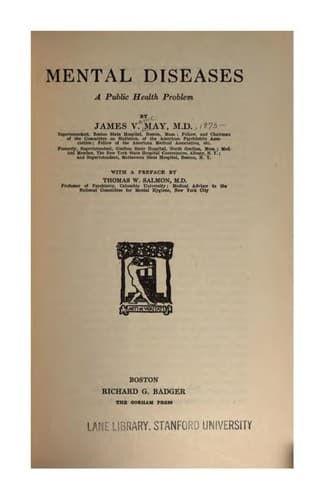
Mental diseases: a public health problemMay, James Vance
Science
Mental diseases: a public health problem
May, James Vance
Mental health services; Psychology, Pathological
The influence of the moon on the mind was taken quite seriously. Rush
seems to have been somewhat in doubt on this subject and suggested the
probability of there being a kind of sixth sense involved—a perception
of the state of the air, and of light and darkness, as Pritchard
expressed it, to which we are insensible in health. It was thought that
the full moon, by rarefying the air, increased the amount of light,
thus affecting the mind. Dr. Rush noted that during an eclipse of the
sun in 1806 "there was a sudden and total silence in all the cells of
the hospital." He expressed the opinion in his "Medical Inquiries and
Observations" in 1812 that there are few cases in which the insane feel
the influence of the moon and that the excitement resulting in such
cases is to be attributed to the resulting increase of light. It is
interesting to note that von Feuchtersleben, an eminent German writer,
in 1845 was unwilling to go on record as stating positively that the
moon was not a factor in the causation of insanity. Esquirol, in his
"Maladies Mentales," in 1838, branded this belief as a superstition,
but admitted that there were certain facts which could not be
overlooked. "It is true that the insane are more agitated at the full
moon as they are also at the dawn of day; but is it not the bright
light of the moon that excites them, as that of the day every morning?
Nevertheless, an opinion which has existed for ages—which has spread
over all lands, and which is consecrated by popular language—demands
the most careful attention of observers." Dr. Allen of the York Lunatic
Asylum was very firmly of the opinion that the moon had a decided
influence on the time of death in mental diseases. This question was
given very serious consideration by various writers as late as 1856.
In the meanwhile efforts were being made to ascertain the cause of
mental disease by means of pathological researches. Morgagni,[59] one of
the earlier investigators, came to the conclusion that the more common
lesions were in the pineal gland, although he found some induration
of the brain and various other well-defined changes. Arnold (1782)
thought that insanity was due to an increased density of the cerebral
substance, particularly, according to Tuke, "of those parts of the
brain by means of which the soul is connected with the body." Pinel
finally concluded that pathology had practically nothing to do with the
problem and Esquirol in 1838 wrote very discouragingly on the subject.
Early contributions of considerable importance were made, however,
by Foville, Bayle, Greding, Calmeil, Guislain, Parchappe and others.
These were confined almost entirely to a study of gross or macroscopic
lesions of the brain. Griesinger in 1845 reviewed the pathological
changes in the nervous system quite thoroughly as far as they were
known at that time. It must be admitted that the greater part of our
knowledge of the pathology of mental diseases was acquired at a much
later date.
Public-domain text, read in full here on John Shaqi.
Reviews
Reviews
No reviews yet
Be the first to share your thoughts on this work.
Elsewhere in the archive
Join the Discussion
Join the discussion
Sign in to leave a comment or review.
Sign InorCreate an account