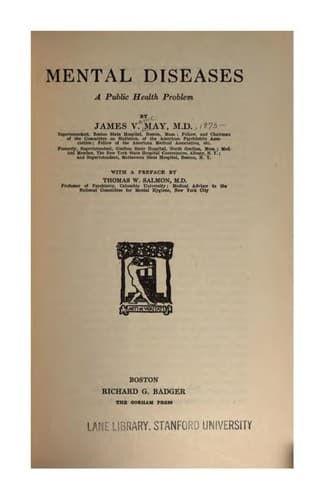
Mental diseases: a public health problemMay, James Vance
Science
Mental diseases: a public health problem
May, James Vance
Mental health services; Psychology, Pathological
This shows some very interesting results. It will be noted that the
Hebrews and Italians have the highest rate for dementia praecox, the
percentage shown by these races being much higher than any of the
others. The Germans, Italians and Hebrews, in the order mentioned,
have the highest rates for manic-depressive psychoses. The frequency
of alcoholic psychoses as shown by the Irish is nearly double that of
any of the others. The Slavonic race has the highest rate for general
paresis, followed in close succession by the French and Germans. The
highest rate for senile and arteriosclerotic psychoses combined is
shown by the races of mixed origin, the next highest by the English,
closely followed by the Irish. The most common psychosis in every
instance is dementia praecox. In the admissions to the institutions for
the criminal insane in New York the highest percentages are represented
by the Irish, Italian and Hebrew races, as shown in another chapter.
During a period of six years (1912 to 1918) a study of first admissions
to the New York state hospitals shows an incidence of dementia praecox
in the native-born of 75.2 per hundred thousand of the population and
in the foreign born of 161.4. The importance of this is shown by the
fact that over fifty per cent of the entire hospital population is made
up of cases of dementia praecox.
The necessity of some supervision of immigration for the purpose of
preventing the entrance of undesirable aliens has long been recognized.
As early as 1824 the state of New York tried by legislation to prevent
the admission of the insane and mental defectives. This effort was
a failure, probably owing to the fact that the proposed enactments
would have compelled the companies responsible for the entrance of
undesirable aliens to remove them if they became a public charge. The
introduction of discordant racial elements from abroad at one time
disturbed the equilibrium of the entire country. The agitation for the
restriction of immigration before the civil war led to the formation
of a political organization known as the "Native American" or "Know
Nothing" party, as it was usually called. It at one time had forty
representatives in Congress and nominated a candidate for President
in 1856. These disturbed conditions led to the consideration of this
subject by Congress as early as 1838 and the Judiciary Committee
recommended legislation prohibiting the entrance of idiots, lunatics
and those suffering from incurable diseases or convicted of crime.
The action of several foreign countries in pardoning murderers with
the provision that they should emigrate to the United States led to
a resolution of protest by Congress in 1860 and shortly thereafter
a statute intended to encourage immigration was repealed. An
investigation made by the United States Immigration Commission brought
to light the fact that the great influx of foreigners was largely
caused by the agents of the steamboat companies abroad and that they
Public-domain text, read in full here on John Shaqi.
Reviews
Reviews
No reviews yet
Be the first to share your thoughts on this work.
Elsewhere in the archive
Join the Discussion
Join the discussion
Sign in to leave a comment or review.
Sign InorCreate an account