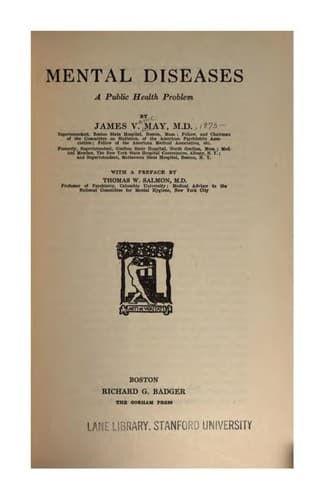
Mental diseases: a public health problemMay, James Vance
Science
Mental diseases: a public health problem
May, James Vance
Mental health services; Psychology, Pathological
The mental condition of the cases committed to the Matteawan State
Hospital is of great importance in a consideration of the relation
of crime to the psychoses. Of 2,595 cases admitted between 1875
and 1907 heredity or congenital defects were shown as etiological
factors in eight per cent of the total number. Of 793 admissions
in which more definite and reliable information was available,
hereditary factors were noted in either the paternal or maternal
branches of the family or both in thirty-five per cent of the cases.
In addition to this, heredity was found in collateral branches in
sixteen per cent. Heredity of some kind was thus shown in 51.3 per
cent of the whole number studied. Of 3,247 admissions, 46.9 per
cent were noted as being intemperate in their habits. An analysis
of 576 unconvicted cases in 1912[83] showed that 41.4 per cent were
diagnosed as dementia praecox, 21.1 per cent as alcoholic psychoses,
6.9 per cent as paranoid conditions, 4.1 per cent as epileptic
psychoses, 7.1 per cent as imbecility with excitements, 2.9 per cent
as manic-depressive psychoses, 2.4 per cent as general paresis,
3.1 per cent as undifferentiated depressions, 6.7 per cent as
constitutional inferiority and 2.2 per cent as not insane. An analysis
of 925 cases committed as insane and charged with criminal offenses
attributable to their mental condition shows the more common crimes
as follows:—assault (all forms), 26.2 per cent, burglary, 7.8, grand
larceny, 8.2, petit larceny, 1, manslaughter, 1.4, murder, 18.9,
homicide (total), 22.4, rape, 3.2, and vagrancy, 4.2 per cent.
Public-domain text, read in full here on John Shaqi.
Reviews
Reviews
No reviews yet
Be the first to share your thoughts on this work.
Elsewhere in the archive
Join the Discussion
Join the discussion
Sign in to leave a comment or review.
Sign InorCreate an account