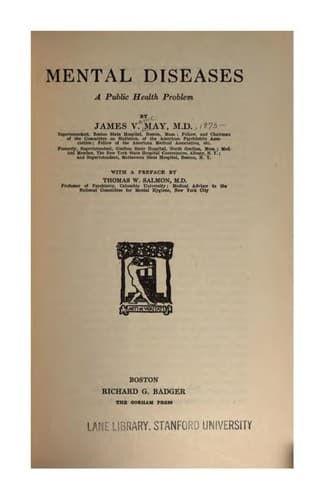
Mental diseases: a public health problemMay, James Vance
Science
Mental diseases: a public health problem
May, James Vance
Mental health services; Psychology, Pathological
highly significant.
Another type of institution for this special group of cases is strongly
indicated. They should be held under an indeterminate sentence and in
some instances committed for life. As a result of hereditary defects,
arrested mental development, ignorance and vicious tendencies this
class furnishes the prisons with our most dangerous criminals. They
should receive separate care, with an opportunity for a special
education adapted to their individual needs. The defective classes
have for centuries been held criminally responsible and have filled our
prisons with incorrigibles and recidivists. Modern civilization should
place at our disposal some means for remedying this situation other
than mere punishment for the possession of an intellectual endowment
for which these individuals are in no way responsible. The ends of
justice can be served and the protection of the public assured at the
same time by a form of medical treatment for the defective delinquent
which will look forward to his ultimate restoration to society rather
than a form of punishment which accomplishes nothing.
CHAPTER XI
THE PSYCHIATRY OF THE WAR
The psychiatry of the late war is of unusual interest from various
points of view. Never before have mental diseases or defects been
looked upon as military problems worthy of any special attention either
in times of war or peace. It is true that the United States government
has maintained a hospital for the treatment of such conditions at
Washington for many years, and medical officers from the army and navy
have been sent to that institution for instruction, from time to time.
No adequate provision has been made, however, in previous wars for
the special care or observation of the psychoses or neuroses, nor has
any great consideration been given to a determination of the mental
status of recruits. It is, of course, equally true that modern military
methods have brought about different conditions and given rise to new
problems. In 1917 and 1918 definite psychiatric organizations were
established by the United States army for the first time. The services
of specialists in mental diseases were utilized extensively and they
were ultimately assigned to practically all of the large hospitals.
Division consultants were soon found necessary and the active
cooperation of practically every psychiatrist available in the country
was required before the armistice was declared.
Public-domain text, read in full here on John Shaqi.
Reviews
Reviews
No reviews yet
Be the first to share your thoughts on this work.
Elsewhere in the archive
Join the Discussion
Join the discussion
Sign in to leave a comment or review.
Sign InorCreate an account