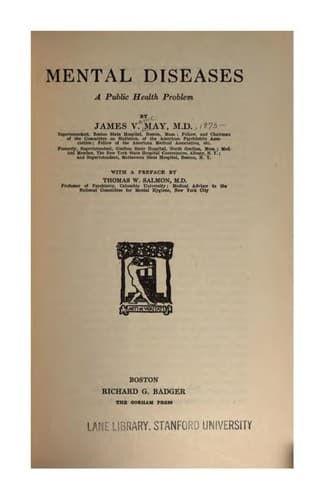
Mental diseases: a public health problemMay, James Vance
Science
Mental diseases: a public health problem
May, James Vance
Mental health services; Psychology, Pathological
and high mental tension." He concludes that "The theory of a psychic
mechanism as the origin of these motor and sensory symptoms is not
demonstrable." "War neurology has demonstrated that emotional shock, in
conjunction with other injuries, may cause a symptom complex identical
in all its details with the well known clinical picture of hysteria."
Wolfsohn,[94] from a study of one hundred psychoneuroses and one
hundred cases of physical injury received on the firing line, reached
the conclusion that war neuroses are very rarely associated with
external wounds. The vast majority of cases studied had a neuropathic
or psychopathic taint, as shown in the family history in fourteen
per cent of the total. A previous neuropathic constitution in the
patient was found in seventy-two per cent. "A gradual psychic shock
from long-continued fear, together with the sudden change from quiet,
peaceful environment to the extraordinary stress and strain of trench
fighting, is the chief predisposing cause of war psychoneurosis in
soldiers with neuropathic predisposition.... Wounded soldiers do not
suffer from war neuroses except in rare instances."
When the United States entered the war, Major, afterwards Colonel,
Thomas W. Salmon[95] of the United States army made an exhaustive
study of "The Care and Treatment of Mental Diseases and War Neuroses
("Shell Shock") in the British Army." At that time one-seventh of
all discharges for disability from the British forces were due to
mental and nervous disorders. As a matter of fact, they accounted for
one-third of all discharges for actual diseases (eliminating wounds).
England with the advantage of three years of experience had presumably
completed her organization to its highest efficiency. One and one-tenth
per cent of the cases in the military hospitals were suffering from
mental diseases. The percentage represented by the expeditionary forces
was 1.3. About six thousand "shell shock" cases were being admitted
annually to the English hospitals. Col. Salmon estimated the admission
rate at two per thousand in the troops at home and four per thousand
in the expeditionary forces. The civilian rate during the same period
was about one to one thousand of the population. The confusion which
existed early in the war was shown by the fact that ten per cent
of the cases sent to the Red Cross Military Hospital at Maghull as
war neuroses turned out to be insane and twenty per cent of those
admitted as mental cases at the Royal Victoria Hospital at Netley were
subsequently found to be suffering from neuroses. The first conclusion
reached by Col. Salmon was that "contrary to popular belief and to some
medical reports published early in the war, no new clinical types of
mental disease have been seen in soldiers. There are no war psychoses."
He found that of the cases being admitted to the hospitals for mental
diseases about eighteen per cent were mental defectives, two per cent
Public-domain text, read in full here on John Shaqi.
Reviews
Reviews
No reviews yet
Be the first to share your thoughts on this work.
Elsewhere in the archive
Join the Discussion
Join the discussion
Sign in to leave a comment or review.
Sign InorCreate an account