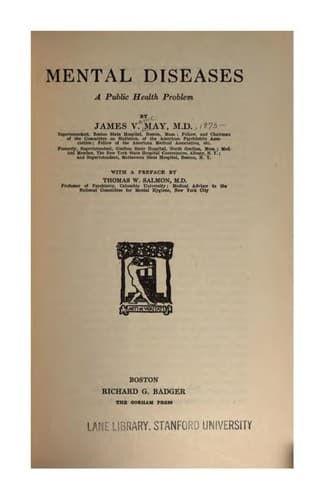
Mental diseases: a public health problemMay, James Vance
Science
Mental diseases: a public health problem
May, James Vance
Mental health services; Psychology, Pathological
unknown in this country. The term lunatic, which first appeared in
the English statutes in 1320, during the reign of Edward the Second,
was still in quite general use. The only state hospital for mental
diseases was the one at Williamsburg, Virginia. Such institutions were
universally known as asylums for many years.
Insanity was generally discussed in the terminology of Pinel and
Esquirol as including mania, melancholia, dementia and idiocy. Those
not thoroughly familiar with the psychiatry of the past may not
understand the sense in which the word dementia was employed. It was
defined by Esquirol in the following terms: "There exists, therefore,
a form of mental alienation which is very distinct—in which the
disorder of the ideas, affections and determinations is characterized
by feebleness and by the abolition, more or less marked, of all the
sensitive, intellectual, and voluntary faculties. This is dementia." It
was looked upon usually as a terminal state following excitements or
depressions and in some rare instances as being primary in origin.
There have been many important developments in psychiatry since the
days of Benjamin Rush. The mania, melancholia and dementia of the
eighteenth century have apparently gone for all time. The events of
the last hundred years include more particularly the delimitation and
complete differentiation of general paresis, the rise and fall of the
paranoia concept, the description of the traumatic psychoses, the
establishment of the alcoholic insanities as clinical entities, a study
of the mental diseases due to endogenous and exogenous toxins, the
recognition of the neuroses and psychoneuroses in their modern sense,
the addition of the psychopathic personalities to our classification
and the definition of manic-depressive insanity, dementia praecox and
involutional melancholia. The mental states due to somatic conditions
have been exhaustively studied and the psychoses associated with
epilepsy and pellagra have been fully investigated. Psychology and
psychiatry have been definitely correlated and pathological research
placed upon a firm foundation. The psychiatric phraseology of today
would have been practically meaningless to the students of Pinel.
Curiously enough the word psychiatry, which goes back to nearly 1800 in
the literature of Germany and Italy has only been used for a few years
in this country and England. The word psychosis is of even more recent
origin.
Public-domain text, read in full here on John Shaqi.
Reviews
Reviews
No reviews yet
Be the first to share your thoughts on this work.
Elsewhere in the archive
Join the Discussion
Join the discussion
Sign in to leave a comment or review.
Sign InorCreate an account