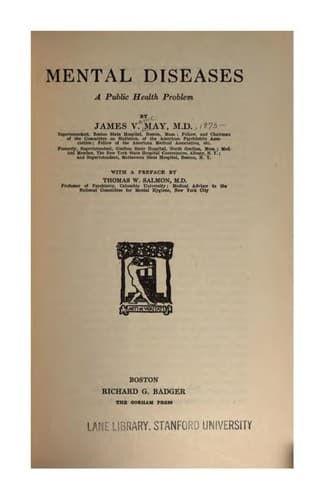
Mental diseases: a public health problemMay, James Vance
Science
Mental diseases: a public health problem
May, James Vance
Mental health services; Psychology, Pathological
This modern era may be said to have been ushered in by the preliminary
studies made of general paresis by Haslam in 1798. These were
followed by the researches of Bayle, Delaye and finally Calmeil,
which definitely established the integrity of that disease as a
clinical entity. Even then its specific origin was only a matter of
conjecture. When Esmarch and Jessen suggested that general paresis
was a syphilitic disease in 1857, their views were rejected by men as
prominent as Charcot and Déjerine. Although paranoia is a term which
has appeared in the literature of medicine for centuries, it has only
had the significance now attached to it since the latter part of the
nineteenth century. Its description was foreshadowed perhaps by the
monomania of Esquirol and Pritchard and the partial insanity of Rush
and others. Heinroth, Griesinger, Magnan, Lasègue, Régis, Falret,
Mendel, Krafft-Ebing, Herz, Snell, Werner, Schüle, Ziehen, Kraepelin
and many other well-known psychiatrists have played a part in the
evolution of paranoia which only definitely displaced the wahnsinn,
verrüchtheit, and various other designations of the earlier writers,
in the neighborhood of 1890. Paranoia is a term which has only been
infrequently used since the general acceptance of Kraepelin's paranoid
forms of dementia praecox. Its territory has been still further invaded
by paraphrenia, the fate of which, however, is somewhat uncertain as
yet. The forerunners of the psychopathic personalities were the moral
insanity of Pritchard, the insanity of degeneracy of Morel, Magnan,
Régis, Lombroso, etc., and the "demifous et demiresponsables" of
Grasset, Trélat and others. The introduction of the "constitutional
inferiority" idea into the psychiatry of this country was directly
attributable to Adolf Meyer following the work of Koch in Germany.
After the elaborate study of alcoholism made by Magnus Huss in 1852 the
psychoses due to that condition were described by Bonhöffer, Magnan,
Korsakow, Kraepelin and various other writers. The psychoneuroses
represent the developments of Brachet, who wrote on hysteria in 1847,
Briquet, Oppenheim, Lasègue, Möbius, Charcot, Janet, Babinski, Beard,
Kraepelin and many others. To Meyer again we are indebted for the
first exhaustive study and classification of the traumatic psychoses.
The description of amentia by Meynert in 1881 was of considerable
significance. The first comprehensive study of mental disorders
associated with the use of cocaine was made by Erlenmeyer in 1886. The
same writer was responsible for the first elaborate investigation of
morphinism in the year following. Circular insanity was described by
Falret in 1851 and again as "folie à double forme" by Baillarger in
1854. Hecker was responsible for an event of great importance in the
history of psychiatry when he published his description of hebephrenia
in 1871. Kahlbaum in his "Katatonia" made a contribution which was
destined to influence the future of medicine in 1874.
Public-domain text, read in full here on John Shaqi.
Reviews
Reviews
No reviews yet
Be the first to share your thoughts on this work.
Elsewhere in the archive
Join the Discussion
Join the discussion
Sign in to leave a comment or review.
Sign InorCreate an account