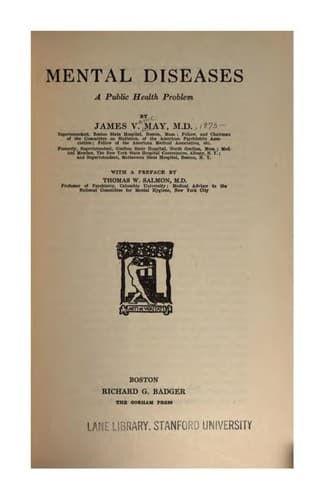
Mental diseases: a public health problemMay, James Vance
Science
Mental diseases: a public health problem
May, James Vance
Mental health services; Psychology, Pathological
Notwithstanding all of these advances, the generally recognized mental
diseases, as late as 1895, included the following types:—mania,
melancholia, dementia, imbecility, idiocy, general paresis, chronic
delusional insanity or paranoia and senile insanity. This was in
substance the psychiatry of Savage, Maudsley, Clouston, Blandfield,
Régis, Chapin, Kellogg, Spitzka, Kirchoff, Berkley and many other
well-known writers of a comparatively recent date. A new era in the
history of mental medicine was ushered in by Kraepelin when the sixth
edition of his "Psychiatrie" appeared in 1899. This established
manic-depressive insanity and dementia praecox as clinical entities.
Kraepelin called attention to the fact that excitements and depressions
frequently recur in the same individual, often with frequent attacks
but with no marked tendency towards mental enfeeblement. This class of
cases he grouped together as manic-depressive psychoses and pointed
out certain characteristics common to the excitements and depressions
included. He showed that certain other forms of depression marked
by anxiety, fear, restlessness, self-accusation, marked suicidal
tendencies, etc., were common to the involutional period of life.
To this anxious depression the name involution melancholia has been
applied, although Kraepelin is now somewhat in doubt as to its
differentiation from the manic-depressive group. To certain other
cases characterized by emotional dulness, apathy, hallucinations with
phantastic delusions, and in some types, mannerisms, negativism,
stereotypy, verbigeration, etc., tending sooner or later towards
deterioration, he attached the name dementia praecox. This included the
hebephrenia of Hecker and the katatonia of Kahlbaum.
Wernicke in 1906 advanced the hypothesis that psychical symptoms may
be attributed to disturbances of various association mechanisms. These
interruptions were to be found in various parts of the psychical
reflex arcs. This included the psychosensory tracts or receptive
mechanisms, the intrapsychical tracts or elaboration mechanisms and the
psychomotor mechanisms. Manic-depressive psychoses were looked upon as
representing a disorder of the intrapsychic mechanism, while dementia
praecox was considered to be an illustration of a disturbance of the
psychomotor mechanisms. This was an exceedingly interesting but purely
theoretical scheme for putting psychiatry on a definite anatomical and
pathological basis.
Public-domain text, read in full here on John Shaqi.
Reviews
Reviews
No reviews yet
Be the first to share your thoughts on this work.
Elsewhere in the archive
Join the Discussion
Join the discussion
Sign in to leave a comment or review.
Sign InorCreate an account