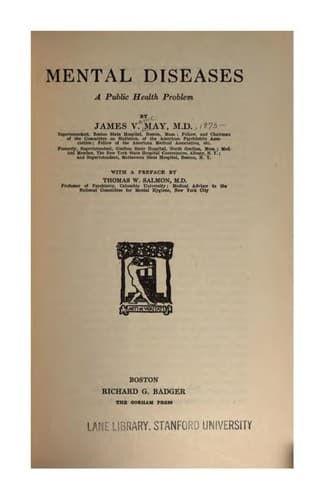
Mental diseases: a public health problemMay, James Vance
Science
Mental diseases: a public health problem
May, James Vance
Mental health services; Psychology, Pathological
In the meanwhile what is to be said as to the progress of pathological
research? The earliest contribution to psychiatry from that point of
view was made by Morgagni in 1761, his opinions being based on the
autopsy reports in some thirteen cases. Greding in 1790 published the
results of autopsies in a series of thirty-seven cases. The findings
at that time included variations in the thickness of the skull,
adhesions and thickenings of the dura, changes in the consistency of
the cerebrum and cerebellum, effusions into the ventricles and various
gross defects. The early writers attached a great deal of importance
to the pineal gland changes. These pathological conditions were so
generally reported, that Portal in the eighteenth century went so far
as to say that "Morbid alteration in the brain or spinal marrow has
been so constantly observed, that I should greatly prefer to doubt the
sufficiency of my senses, if I should not at any time discover any
morbid change in the brain, than to believe that mental disease could
exist without any physical disorder in this viscus, or in one or other
of its appurtenances." Pinel spoke very discouragingly, however, of the
results and Esquirol finally reached the conclusion that nothing really
important had been accomplished after all. In his Charenton reports
(1835) he expressed himself on this subject as follows:—"However
important may have been the researches of anatomists made during our
days into diseases which affect the mind, we may venture to repeat
that pathological anatomy is yet silent as to the seat of madness,
and that it has not yet demonstrated what is the precise alteration
in the encephalon which gives rise to this disease. What shall we,
then, think of the rash pretensions of those who assume that they can
fix upon the diseased portion of the brain, judging merely from the
character of the disease?" In 1836 Guislain summarized the various
lesions found in insanity at autopsy under nine headings—congestion of
the brain or meninges or both, serous congestion of the same, cerebral
softening, adhesions of the membranes to each other or to the brain,
cerebral induration, cerebral hypertrophy, and abnormalities of the
brain or skull. The appointment of a pathologist at the Utica State
Hospital in 1868 as a result of the remarkable interest taken in this
subject by Dr. John P. Gray must be looked upon as one of the important
events in the history of American psychiatry. The later developments of
the nineteenth century included studies of general paresis, cerebral
syphilis, arteriosclerosis, senility, epilepsy, mental deficiency,
pellagra and various other somatic conditions. It may fairly be said,
at least, that pathology has kept fully abreast of the progress made by
clinical psychiatry during the nineteenth century.
Public-domain text, read in full here on John Shaqi.
Reviews
Reviews
No reviews yet
Be the first to share your thoughts on this work.
Elsewhere in the archive
Join the Discussion
Join the discussion
Sign in to leave a comment or review.
Sign InorCreate an account