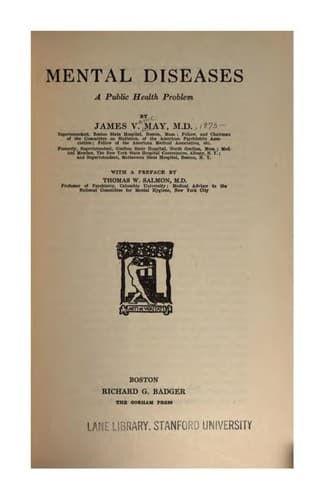
Mental diseases: a public health problemMay, James Vance
Science
Mental diseases: a public health problem
May, James Vance
Mental health services; Psychology, Pathological
When the American Psychiatric Association first approached the problem
of formulating a definite scheme for the collection of statistical
data relating to mental diseases it was immediately confronted with
the necessity of adopting an official classification of psychoses
purely for purposes of uniformity. This undertaking, which suggested
no difficulties at the outset, led to all kinds of unexpected
complications and embarrassments. Classifications of "insanity" are
almost as old as the terms mania and melancholia and have been given a
grossly exaggerated importance by the space which for so many years has
been devoted to a consideration of this subject in textbooks. This, if
nothing else, appears to have been demonstrated quite clearly by the
discussions of the last few years.
A review of the literature of psychiatry shows that attempts to
classify the psychoses date back almost to the beginning of medical
history. Hippocrates is said to have recognized three forms of mental
disorders—mania, melancholia and dementia, although there is some
question as to his having used those terms in accordance with their
present significance. Celsus[130] also described three forms of
insanity. The first, which was accompanied by febrile symptoms, he
termed phrenitis. The second was characterized by sadness and caused by
black bile. The third was accompanied in some cases by false images,
while in others the whole mind or judgment was impaired. The Roman law
divided the dementes or mad into two classes, the excited or violent
(furiosi) and those deficient in intellect (menti capti). Aretaeus[131]
discussed mania, melancholia and dementia, apparently regarding them
as all manifestations of some one disease process. Melancholia, he
said, "does not affect all the faculties of the mind; the patients are
sad and dismayed; they are without fever." He described it as only
an initial stage of mania. Caelius Aurelianus[132] did not regard
melancholia as a form of insanity, "from which disease it differs in
that the stomach chiefly suffers, while in Madness it is the head."
Galen in his writings referred to amentia or dementia, imbecility,
mania and melancholia.
Public-domain text, read in full here on John Shaqi.
Reviews
Reviews
No reviews yet
Be the first to share your thoughts on this work.
Elsewhere in the archive
Join the Discussion
Join the discussion
Sign in to leave a comment or review.
Sign InorCreate an account