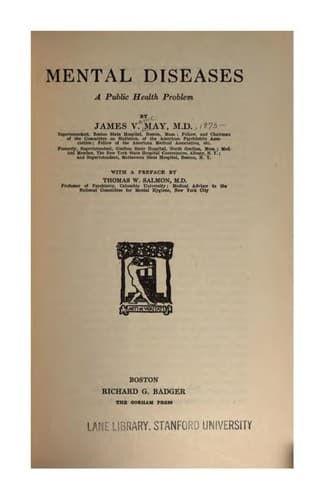
Mental diseases: a public health problemMay, James Vance
Science
Mental diseases: a public health problem
May, James Vance
Mental health services; Psychology, Pathological
In the sixteenth century Felix Plater[133] devised the following
classification: 1. Mentis imbecillitas: Hebetudo, tarditus, oblivio,
imprudentia. 2. Mentis consternatio: Somnus immodicus, carus,
lethargus, apoplexia, epilepsia, convulsio, catalepsis, ecstasis.
3. Mentis alienatio: Stultitas, temulentia, amor, melancholia,
hypochondriacus morbus, mania, hydrophobia, phrenitis, saltus viti.
4. Mentis defatigatio: Vigiles, insomnia. Linnaeus[134] in 1763 called
his fifth class of diseases Mentales, divided into three orders:
Ideales, Imaginarii and Pathetici. Sauvages in the same year included
Hallucinationes, Morositates and Deliria under the heading of Vesaniae
in his "Nosologia Methodica." Vogel[134] in 1764 divided Paranoiae
into mania, melancholia, and amentia. Cullen in 1772 included insanity
or the Vesaniae in the neuroses, divided into four groups—Amentia,
Melancholia, Mania and Oneirodinia. He described eight varieties of
melancholia and three of mania. Oneirodinia included somnambulism and
nightmare. According to Jelliffe, Plocquet described six varieties of
delirium in his treatise on paranoia in 1772. Pinel in 1791 limited
himself to four classes of insanity—mania, melancholia, dementia
and idiotism. He looked upon melancholia as a delirium exclusively
directed upon one object or series of objects and accompanied by
sadness. Idiotism was an advanced form of dementia. Esquirol in 1838
modified Pinel's scheme somewhat and described Lypemania, Monomania,
Mania, Dementia and Imbecility or Idiocy. The active discussion of
classifications of various kinds led Pritchard[135] to make the
following interesting comment in 1822: "I cannot conceive anything
more preposterously absurd than the attempt to classify diseases with
all the divisions and technology of a botanical or zoological system,
and to force what is essentially disorder and confusion to assume the
appearance of that order and symmetry which nature displays in the
arrangement of the organized world. An aetiological classification
is the only mode of terminology and arrangement that can be of any
practical advantage, and that is all that we have to consult."
He nevertheless published a classification of his own which was
essentially psychological in principle, although containing nothing new.
The German school of this time was exceedingly prolific in the
production of classifications, as will be shown by the following
interesting and elaborate scheme of Flemming's[136] published in 1844:—
FAMILY-AMENTIA—MENTAL DISEASES
_First Group_—Infirmitas (Feeblemindedness).
Varieties:
A. According to etiology:
1. Inf. primaria, or congenita (Idiocy)
2. Inf. secundaria, or acquisita (Imbecility)
a. Inf. e. morbo (Brain injuries, encephalitis, epilepsy, etc.)
b. Inf. senilis
Public-domain text, read in full here on John Shaqi.
Reviews
Reviews
No reviews yet
Be the first to share your thoughts on this work.
Elsewhere in the archive
Join the Discussion
Join the discussion
Sign in to leave a comment or review.
Sign InorCreate an account