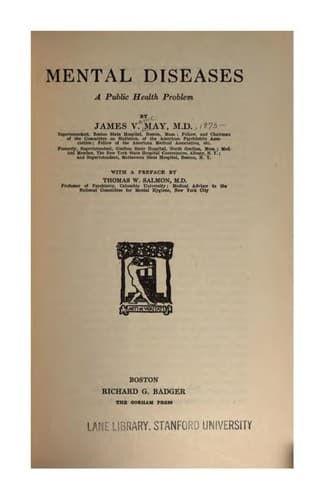
Mental diseases: a public health problemMay, James Vance
Science
Mental diseases: a public health problem
May, James Vance
Mental health services; Psychology, Pathological
The excitement may last for months or even for a year or more and
often stops suddenly, always with deterioration later. In the
cases which have come to autopsy Alzheimer has reported severe and
widespread cell alterations, fibre loss, glia reactions, and changes
in the vessel walls, somewhat suggesting the pathological findings
in general paresis. The cases in this group usually have been of the
male sex between sixty and seventy years of age. Kraepelin speaks of
the clinical picture as a mixture of the symptoms of general paresis,
katatonia and manic-depressive psychoses and it is usually diagnosed as
one or the other of these conditions.
The paranoid presenile forms occur usually in women. Consciousness is
clear, although there may be a mild anxiety or hypochondriasis. The
persecutory ideas are variable and changeable. Delusions of jealousy
are common although hallucinations are infrequent. Memory is often
somewhat impaired and retrospective falsifications are occasionally
observed. The mood is as a rule anxious and suspicious. Suicidal
tendencies often appear. Restlessness, excitement, impulsive actions
and outbursts of anger are noted at times. Rarely a more cheerful mood
develops. The disease may become stationary and show no marked changes
for years.
Kraepelin himself seems to be very uncertain as to the significance and
the delimitation of these various presenile forms. It must be confessed
that some of the types described very strongly suggest the condition
formerly looked upon by him as involutional melancholia. It will be
noted that he considers as possible etiological factors the disturbance
of metabolism which may result from regressive or involutional
processes. The differentiation from manic-depressive forms, from
arteriosclerotic disorders and from senile psychoses must also be
looked upon as presenting some difficulties which cannot be entirely
disregarded. Many possibilities suggest themselves.
In the senile deteriorations Kraepelin notes particularly a loss in
the capacity of apprehension and perception, with a sluggishness of
the train of thought, a dulling of the emotions, a reduction of energy
and the development of conduct disorders. Ranschburg in psychological
tests noticed a lengthening of the reaction time, with a delay in the
choice of action, the reading of words, the performance of addition,
and the formation of judgment. The retardation was shown particularly
in psychic processes and the association time. The reactions were,
moreover, much more monotonous, irregular and unreliable than in the
young. Memory tests also showed poor associations.
Public-domain text, read in full here on John Shaqi.
Reviews
Reviews
No reviews yet
Be the first to share your thoughts on this work.
Elsewhere in the archive
Join the Discussion
Join the discussion
Sign in to leave a comment or review.
Sign InorCreate an account