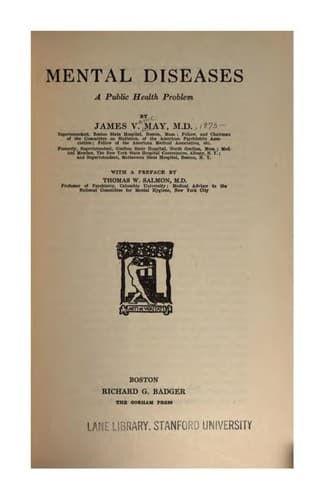
Mental diseases: a public health problemMay, James Vance
Science
Mental diseases: a public health problem
May, James Vance
Mental health services; Psychology, Pathological
The most advanced form Kraepelin describes as senile dementia, a
progressive mental enfeeblement in which the loss of apprehension
and memory becomes a conspicuous feature. The perception of external
impressions is diminished and delayed and there is a profound disorder
of attention. Memory of the remote past is much better than it is for
current events. Retrospective falsification is a common symptom. The
patient is, moreover, unable to change old viewpoints or acquire new
ones. Delusional manifestations such as childish egotism, foolish
suspicions or notions of impending illness develop. Grandiose ideas
often occur, delusions of great wealth being common. These symptoms
are transitory and come and go without apparent reason. In some cases
the hallucinations resemble those found in the alcoholic psychoses.
Sooner or later there is a disturbance of consciousness leading to
a dreamlike existence suggesting a delirium. There is a noticeable
dulling of the emotional feelings. The patients become indifferent
and apathetic, losing interest in their surroundings, and are often
irritable and excitable. In a certain number of cases depressive
states develop, sometimes with suicidal tendencies. The delusions
may be hypochondriacal or nihilistic in character. Complaints of
persecution are common. Some of the patients show a simple, childish
deterioration with seclusive tendencies. Stuporous or cataleptic states
may develop. Others become uneasy, wander in the streets, remove their
clothes, collect rubbish, or show sexual excitement. Restlessness at
night is especially suggestive.
Delirious excited states ("Senile Delirium") characterized a certain
number of Kraepelin's cases. In these, clouding of consciousness is
marked. The presbyophrenic complex described by Kahlbaum often occurs.
These cases are fairly clear mentally at first, as far as their
surroundings are concerned, but show memory disturbances, particularly
for recent events. Orientation is lost very soon and they fail to
recognize old friends and relatives. Fabrications are resorted to for
the purpose of remedying these defects of memory and delusions are very
common. Nevertheless, judgment about many things is well retained. In
some instances, however, orientation for time, place and person is
completely lost. Kraepelin is in doubt as to whether presbyophrenia
should be looked upon as constituting a definite entity or only a form
of senile insanity. It may last for years or terminate in a marked
deterioration. In some of the senile cases arteriosclerotic changes
in the cortex are very pronounced. This is more noticeable in the
depressive and anxious forms and in the incoherent varieties. These
individuals become clouded, incoherent, and deteriorate rapidly.
Public-domain text, read in full here on John Shaqi.
Reviews
Reviews
No reviews yet
Be the first to share your thoughts on this work.
Elsewhere in the archive
Join the Discussion
Join the discussion
Sign in to leave a comment or review.
Sign InorCreate an account