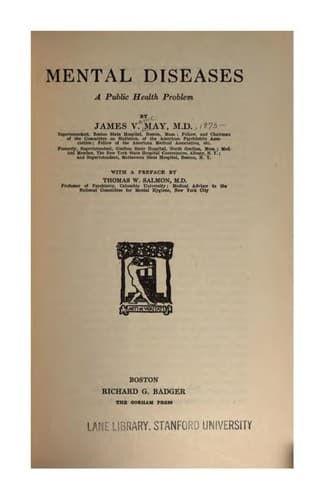
Mental diseases: a public health problemMay, James Vance
Science
Mental diseases: a public health problem
May, James Vance
Mental health services; Psychology, Pathological
"(a) Simple deterioration: Retention and memory defects, reduction
in intellectual capacity and narrowing of interests; usually also
suspiciousness, irritability and restlessness, the latter particularly
at night.
"(b) Presbyophrenic type: Severe memory and retention defects with
complete disorientation; but at the same time preservation of
mental alertness and attentiveness with ability to grasp immediate
impressions and conversation quite well. Forgetfulness leads to absurd
contradictions and repetitions; suggestibility and free fabrication are
prominent symptoms. (The general picture resembles the Korsakow mental
complex.)
"(c) Delirious and confused types: Often in the early stages of the
psychoses and for a long period the picture is one of deep confusion
or of a delirious condition.
"(d) Depressed and agitated types: In addition to the underlying
deterioration there may be a pronounced depression and persistent
agitation.
"(e) Paranoid types: Well marked delusional trends, chiefly persecutory
or expansive ideas, often accompany the deterioration and in the early
stages may make the diagnosis difficult if the defect symptoms are mild.
"(f) Pre-senile types: The so-called 'Alzheimer's disease.' An early
senile deterioration which usually leads rapidly to a deep dementia.
Reported to occur as early as the fortieth year. Most cases show an
irritable or anxious depressive mood with aphasic or apractic symptoms.
There is apt to be general resistiveness and sometimes spasticity.
"(g) Other types."
The frequency of senile cases is shown by the fact that of 84,143
admissions to the New York hospitals during a period of sixteen years,
12,017, or 14.2 per cent, were over sixty years of age, while 8.4
per cent were between sixty and seventy years old, and 4.5 per cent
between seventy and eighty. Of 49,640 first admissions to the New York
state hospitals during eight years 4,724 cases, or 9.52 per cent,
were diagnosed as senile psychoses. They constituted 9.63 per cent of
the admissions in Massachusetts during 1919 and 10.61 per cent of the
18,336 admissions to twenty-one hospitals in fourteen other states. Of
70,987 admissions to all of the institutions referred to, 6,961, or 9.8
per cent, were senile psychoses.
Public-domain text, read in full here on John Shaqi.
Reviews
Reviews
No reviews yet
Be the first to share your thoughts on this work.
Elsewhere in the archive
Join the Discussion
Join the discussion
Sign in to leave a comment or review.
Sign InorCreate an account