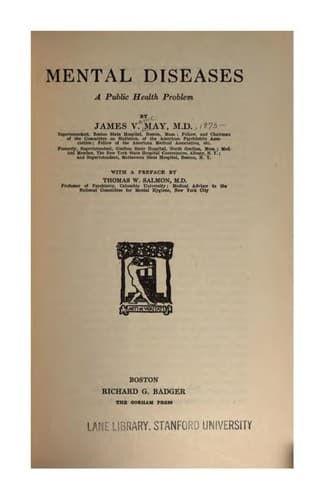
Mental diseases: a public health problemMay, James Vance
Science
Mental diseases: a public health problem
May, James Vance
Mental health services; Psychology, Pathological
Our present knowledge as to the relation of syphilis to this disease
has not changed the significance of the observations made by Osler in
any way. Heredity more than any other one factor undoubtedly determines
the development of both senility and arteriosclerosis. "When," as
Lambert[163] expresses it, "physiological involution anticipates in time
or exceeds in direction, extent and severity normal senescence, the
various senile and arteriosclerotic disorders are the result." It is
as a rule only in the later stages of the disease when focal symptoms
occur or a psychosis develops that hospital care becomes necessary.
Practically any of the vessels of the brain may be involved and it
frequently happens that more than one is affected either directly or
indirectly. The neurological symptoms resulting depend entirely on the
location and extent of the lesion. Lambert[164] has made the following
excellent anatomical classification of the more common arteriosclerotic
processes:—
I. Incipient type.
II. Focal types.
(a) Trunk disorders.
1. Basilar-carotids.
(b) Branch disorders.
1. Inferior cerebellar.
2. Superior cerebellar.
3. Posterior cerebral.
4. Middle cerebral.
5. Anterior cerebral.
(c) Twig disorders.
1. Medullary.
2. Cortical.
Some reference should be made, perhaps, to the focal symptoms resulting
from more or less sharply circumscribed lesions which are productive of
certain fairly well known complexes, whether due to arteriosclerotic
softenings, hemorrhages, or growths. These have been concisely
summarized by Barker[165] somewhat as follows:—
Frontal Lobes—Lesions of the left inferior frontal in righthanded
persons cause motor aphasia. Subcortical involvements cause word
dumbness. Disturbances in the anterior part of the frontal region are
sometimes associated with the Witzelsucht of the German writers—a
tendency towards joking and witticisms.
Central and Paracentral Lobules—Contralateral sensory, motor symptoms
or a combination of the two. Monoplegias, anesthesias and Jacksonian
epilepsies are characteristic. Contralateral tactile agnosia and
apraxia occur, especially in lesions of the left hemisphere. An
involvement of the left side may also cause a homolateral apraxia,
dyspraxia or a tactile agnosia.
Parietal Lobes—Lesions in the anterior part cause contralateral
somesthetic disturbances, tactile agnosia or apraxia. Involvement of
the left angular gyrus may cause optic aphasia or alexia; if deep
enough, hemianopsia results. The voluntary movement of the eye may be
interfered with.
Public-domain text, read in full here on John Shaqi.
Reviews
Reviews
No reviews yet
Be the first to share your thoughts on this work.
Elsewhere in the archive
Join the Discussion
Join the discussion
Sign in to leave a comment or review.
Sign InorCreate an account