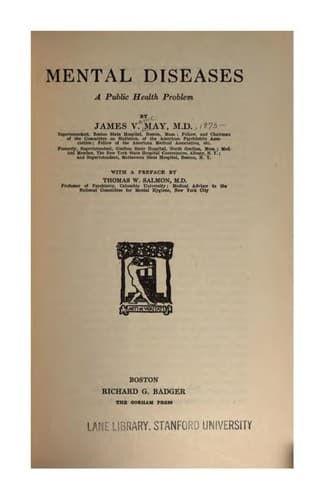
Mental diseases: a public health problemMay, James Vance
Science
Mental diseases: a public health problem
May, James Vance
Mental health services; Psychology, Pathological
Clinically Kraepelin[168] divides the arteriosclerotic psychoses into
deteriorations, or milder forms of mental enfeeblement, dementias,
depressions, excitements, late epilepsies, and apoplectic dementia.
In the milder forms there is a gradual change in the entire psychic
personality, with a later development of more marked changes, either
physical, mental or both. The early symptoms are a general reduction
of the mental capacity and an impairment of memory. The patient tires
easily and loses all evidences of energy, with no inclination to
undertake anything new. Familiar names and dates are forgotten. Recent
occurrences are particularly lost to memory. The real is confused with
the false. In business the patient becomes careless and unreliable,
overlooks important transactions and forgets appointments. There are
often subjective feelings of impending illness. The mood becomes
depressed, whining and tearful. Irritability and outbursts of anger
occasionally appear, characterized by a marked emotional instability,
varying rapidly from tears to laughter. Suicidal tendencies are
sometimes noted. Mild confusional states may be induced by alcoholic
indulgences. Early physical symptoms are headache, sensations of
fulness and pressure in the head, followed by a feeling of dizziness,
fatigue, exhaustion, debility, etc. Sooner or later, following a
seizure of some kind, neurological signs appear—drooping of the
mouth, lateral deviation of the tongue, weakness of an arm, dragging
of one leg, loss of sensation on one side, ankle clonus, an increase,
decrease or inequality of the patellar reflexes, and sometimes a
Babinski reflex. The pupils are very likely to be unequal and sluggish
in reaction. The features present a tired, sleepy expression and
speech becomes tremulous and monotonous. There may be a difficulty
in finding words, or the misuse of words. There are usually tremors
of the fingers and movements are uncertain, the gait being unsteady.
Romberg's symptom may be present. Dizzy spells and fainting attacks
also occur, sometimes followed by genuine convulsions. Apoplectiform
seizures may be observed, with unconsciousness for hours or days. These
may be followed by sensory or motor aphasia, unilateral paralysis with
or without disturbances of sensation, hemianopsia, alexia, agraphia,
asymbolism or apraxia. Cardiac disturbances with anxieties are often
complications. These apoplectiform and other severe attacks sometimes
occur a long time after mental symptoms have appeared. They are likely
to recur, mental deterioration progressing rapidly with the repetition
of the seizures.
Public-domain text, read in full here on John Shaqi.
Reviews
Reviews
No reviews yet
Be the first to share your thoughts on this work.
Elsewhere in the archive
Join the Discussion
Join the discussion
Sign in to leave a comment or review.
Sign InorCreate an account