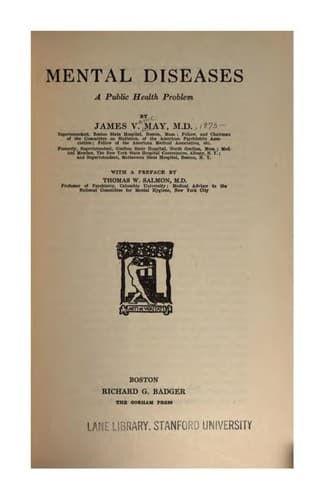
Mental diseases: a public health problemMay, James Vance
Science
Mental diseases: a public health problem
May, James Vance
Mental health services; Psychology, Pathological
Apprehension is much disturbed and memory weakened, in the advanced
cases of deterioration. The patients cannot remember anything for
more than a short time. They become disoriented as to time, place and
person and forget their own names. Genuine "confabulation" sometimes
appears. There are often confusional and delirious states. The mood is
frequently depressed or anxious, sometimes irritable or quarrelsome
and at times humorous. There is a group of cases showing genuine
depressions, usually with hypochondriacal delusions, sometimes with
delusions of persecution, self-accusation, and ideas of sinfulness.
Even delusions of grandeur are observed. Hallucinations are not
infrequent in these cases. States of excitement may intervene with
occasional delusions and confused attacks. These excitements are
usually of the agitated, restless type, sometimes with suicidal
inclinations. Stuporous or even cataleptic states may follow. In the
highest forms of excitement sensory or motor aphasia may develop,
often with speech disturbances, sometimes of a genuine scanning
type. Paraphasias are common. The writing is ataxic or paragraphic.
Ideational or motor apraxia often is a symptom. Cyanoses and other
evidences of general arteriosclerotic involvement appear. There may be
an albuminuric retinitis. Albumen and sometimes sugar appear in the
urine. The radials and temporals are thickened or hardened and cardiac
murmurs are often found. Blood pressure is greatly increased in many
instances, although Romberg found it in only ten per cent of his cases.
Sleep is usually interfered with to a marked degree.
In a certain number of the more advanced cases of arteriosclerosis late
epilepsies appear. The attacks usually begin between the forty-fifth
and sixty-fifth years. There may be fainting spells or genuine
convulsions recurring at frequent intervals. These may be associated
with brief periods of delirium or may even occur without loss of
consciousness. Forgetfulness and mental enfeeblement soon appear in
such cases. They also show physical changes with tremors, disturbed
reflexes, paralyses, increased blood pressure, etc. Alcoholism seems
to be a strongly predisposing factor in this form of arteriosclerotic
disorder. Kraepelin found that the epileptic attacks almost invariably
appeared in cases which showed a previous history of alcoholic excesses.
Public-domain text, read in full here on John Shaqi.
Reviews
Reviews
No reviews yet
Be the first to share your thoughts on this work.
Elsewhere in the archive
Join the Discussion
Join the discussion
Sign in to leave a comment or review.
Sign InorCreate an account