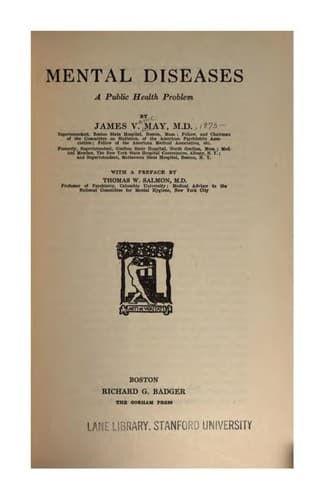
Mental diseases: a public health problemMay, James Vance
Science
Mental diseases: a public health problem
May, James Vance
Mental health services; Psychology, Pathological
In the young, apoplectic attacks are usually due to cerebral softening,
thrombosis following acute disease or embolism resulting from
endocarditis. Between the ages of twenty and forty apoplexies usually
mean syphilitic thrombosis. In the later decades of life, either
hemorrhage, thrombosis, embolism or softening may occur. Thomas[197]
collected from various hospitals, statistics of 840 cases. Of these,
499 showed hemorrhages and 341 softenings. He is of the opinion that
the presence of premonitory symptoms for some days indicate thrombosis,
while shorter prodromal periods point to a hemorrhage. Rapidly
developing coma suggests hemorrhage, while a widespread paralysis
without much disturbance of consciousness is more common in thrombosis.
A marked fall of temperature and rise of blood pressure as a rule
means a hemorrhage. Repeated convulsions are more often associated
with softening or embolism. If the symptoms indicate a capsular lesion
it favors hemorrhage, and if of a cortical type, softenings are
more likely. A positive Wassermann reaction suggests thrombosis or
softening. The presence of endocarditis with heart murmurs points to
embolism. Thomas finds that, while the patient may recover from either
of these conditions without apparent intellectual defect, he is liable
to be petulant, emotional, depressed and tire easily.
In psychoses following hemorrhage, thrombosis and embolism
Kraepelin[198] as a rule finds very little relation between the nature
of the lesion in question and the symptoms to be expected. Immediately
following the seizure the patients become dull, clouded, confused
and disoriented, and peculiar in their behavior. This is followed by
an active excitement with loud cries, resistiveness and struggling.
These acute disturbances usually subside, leaving, however, evidences
of the arteriosclerosis or syphilitic endarteritis which caused the
hemorrhage or thrombosis. Embolism may leave an apparently permanent
mental deterioration with aphasic and paraphasic manifestations which
often entirely clear up. In lesions of younger persons due to syphilis,
mental enfeeblement may follow.
Public-domain text, read in full here on John Shaqi.
Reviews
Reviews
No reviews yet
Be the first to share your thoughts on this work.
Elsewhere in the archive
Join the Discussion
Join the discussion
Sign in to leave a comment or review.
Sign InorCreate an account