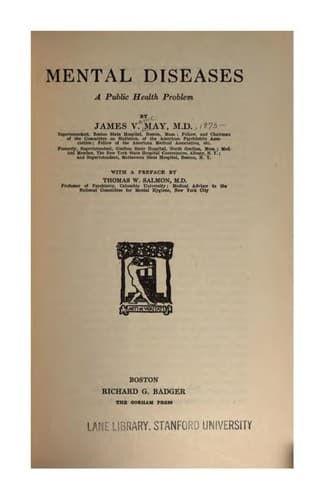
Mental diseases: a public health problemMay, James Vance
Science
Mental diseases: a public health problem
May, James Vance
Mental health services; Psychology, Pathological
gradual process, to undermine the fabric of his health and destroy the
property of his family."
Curiously enough the word alcohol is of Arabic origin and was employed
originally to describe a powder used in applications to the eyebrows
for cosmetic purposes. It was subsequently used for centuries as
referring to a fine powder of any kind, as is shown by the writings
of Paracelsus and others. The chemical composition of alcohol was not
known until 1808, when it was described by Lavoisier. On the other
hand, Salvatori in 1817 and Hufeland in 1818 referred to dipsomania
as a disorder due to alcoholism. Esquirol, Trélat and other early
writers included it in the "partial" insanities. Morel described it
as an impulsive form of "délire émotif" and looked upon it as an
hereditary condition. It has been classified with the periodical
insanities and even as a form of melancholia. Magnan saw in it an
episode of the insanity of degeneracy. Magnus Huss was responsible for
the introduction of the term "chronic alcoholism" as descriptive of a
pathological condition in 1852.
It is said that Caelius Aurelianus protested against the use of
intoxicants in the treatment of the insane. Notwithstanding this early
reference to a question of such importance, and the inauguration of
the great temperance crusade which began in 1808, it has been shown
by Tuke[214] that alcoholic beverages were issued in a routine way to
patients and employees of the British asylums for the insane less than
forty years ago. "Thirty superintendents hold that they have observed
very beneficial results from the course pursued. The improvement
usually refers not only to the patients, but to the discipline of the
asylum." The cost of beer supplied to the inmates at the Glamorgan
Asylum at one time was reported to be as high as two hundred and sixty
pounds per year (Tuke). Beer was not discontinued as a regular article
of diet for patients at the Derby Asylum until 1884.
In 1844 Flemming[215] in his classification of psychoses mentioned
the following forms of alcoholic insanity:— Ferocitas et morositas
ebriosorum, anoësia e potu, anoësia semisomnis, delirium tremens, and
mania à potu. Clouston[216] described acute and chronic forms—mania à
potu, dipsomania, alcoholic dementia and degeneration. Krafft-Ebing[217]
speaks of hallucinations of the inebriate, delirium tremens, alcoholic
melancholia, mania gravis potatorum, hallucinatory insanity, alcoholic
paranoia, alcoholic paralysis and epilepsy. Delirium tremens he
ascribes either to repeated excesses (à potu nimio), abstinence (à potu
intermisso), insufficient nourishment, violent emotions, pneumonia and
other acute diseases, loss of sleep, injuries such as fractures, etc.
By hallucination of the inebriate (sensuum fallacia ebriosa) he refers
to the transitory hallucinations of the constant drinker. Meyer[218]
has described an alcoholic constitution "as shown by the lachrymose,
prevaricating, jealous deterioration of the drinker."
Public-domain text, read in full here on John Shaqi.
Reviews
Reviews
No reviews yet
Be the first to share your thoughts on this work.
Elsewhere in the archive
Join the Discussion
Join the discussion
Sign in to leave a comment or review.
Sign InorCreate an account