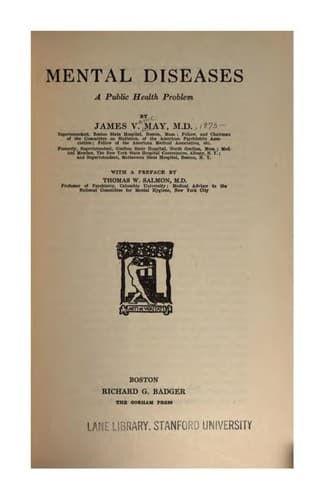
Mental diseases: a public health problemMay, James Vance
Science
Mental diseases: a public health problem
May, James Vance
Mental health services; Psychology, Pathological
The course of the disease is characterized by great restlessness often
with a tendency to talkativeness. There is, however, no flight of ideas
or rhyming. Delusions of persecution occur in some cases. Anesthesias,
hyperesthesias, paresthesias, hypalgesias and sensitiveness of nerves
and muscles are noted. Romberg's sign is present in some instances.
Speech is often ataxic and paraphasic, and in advanced eases entirely
meaningless. Tremors of the tongue and fingers are very characteristic.
Writing is very much affected as a result. Epileptiform convulsions
sometimes occur. Rarely focal symptoms, facial paralysis and hemiplegia
appear for a short time. Reflexes are increased and ankle clonus
occasionally appears. Defective papillary reaction and unequal pupils
may be found, with diplopia and muscular weakness. Sleep is seriously
interfered with. Bodily weight is reduced and blood pressure lowered.
The temperature is usually elevated and the pulse accelerated. Albumen
and sometimes sugar is present in the urine. The delirium often stops
as suddenly as it begins, terminating in sleep, the patient being
clear when he wakes. The memory of events is not well retained on
recovery. The delirium may, however, become chronic and last for
months. Some cases terminate in a hallucinatory feeblemindedness.
This is likely to occur in psychopathic individuals. Hallucinations
of hearing are more common in such conditions. People read their
thoughts and influence their minds. They are subjected to hypnotism
and electricity. The delusional ideas may be of a sexual nature or
grandiose in character. The mood may be anxious or irritable. Suicidal
tendencies sometimes appear. Later a humorous trend is often noted.
Tremors and other neurological symptoms sometimes occur. Bonhöffer
found at autopsy a considerable fibre loss in the central convolutions,
the cerebellum and the column of Goll. In the large pyramidal and
motor cells of the anterior central convolution the processes were
deeply stained. Some nuclear changes were noted and occasional cells
destroyed. Nissl described a granular degeneration of the neurones
with a prominence of the "unstainable" substance, together with a
swelling and crumbling of the cell bodies. Alzheimer often found free
nuclei near the apical processes. In the glia cells and vessel walls
granular detritus was observed. Acute and chronic cell alterations
are more common in old alcoholics. Pachymeningitis hemorrhagica is
sometimes found. Kraepelin considers it very doubtful whether wine or
beer drinking ever causes delirium tremens, whisky and gin being the
etiological factors as a general rule.
Public-domain text, read in full here on John Shaqi.
Reviews
Reviews
No reviews yet
Be the first to share your thoughts on this work.
Elsewhere in the archive
Join the Discussion
Join the discussion
Sign in to leave a comment or review.
Sign InorCreate an account