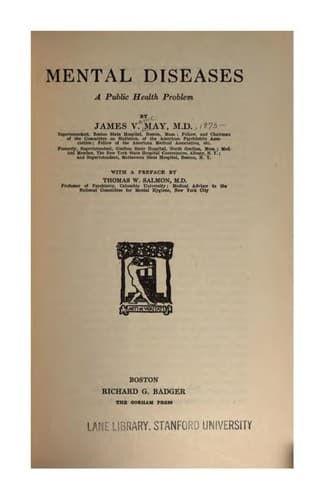
Mental diseases: a public health problemMay, James Vance
Science
Mental diseases: a public health problem
May, James Vance
Mental health services; Psychology, Pathological
Korsakow's psychosis was first described in 1887. This is characterized
by a loss of memory, and falsification, with a marked tendency
to disorientation, and is often due to chronic alcoholism. It is
practically always accompanied by polyneuritic symptoms. According
to Bonhöffer, it usually follows delirium tremens. This occurred in
one-fourth of Kraepelin's cases. Occasionally it begins suddenly, but
as a rule gradually, during the course of a chronic alcoholism. The
patients frequently complain of dizziness, headaches and fainting
spells. In the foreground of this affection is the impairment of
memory. This is one of the characteristic features. The events of a
few hours ago are completely forgotten. Disorientation appears next.
This affects time more than anything else. The power of apprehension
or perception is very markedly impaired (one-sixth of the normal in
Kraepelin's cases) and the reaction time is greatly increased. He
also found memory reduced to one-third or one-fourth of the normal on
actual tests (repetition of words and syllables). Falsification of past
events is also demonstrable. This often leads to elaborate delusion
formations. The mood is usually anxious at first, later indifferent,
dull, suspicious, irritable, in some eases cheerful and even humorous.
The methods of life are completely changed. The patients neglect
themselves, lie in bed, etc. The physical signs are those of neuritis.
Muscular pains in the limbs appear, with evidences of loss of power.
Paraplegias and weakness of the grip are found. Romberg's sign is
frequently present. Anesthesias, hyperesthesias or paresthesias are
noted. The reflexes are usually decreased, rarely increased. Ataxia and
other difficulties of gait are common. The pulse is usually slower as a
result of involvement of the vagus. Speech difficulty, writing defects,
facial paralyses, weakness of the eye muscles, with inequality and
inactivity of the pupils, are to be expected. There are usually tremors
of the fingers. Epileptiform convulsions are not infrequent. Aphasia,
agraphia, apraxia, monoplegia, hemiplegic, etc., are observed in many
cases. Physical disturbances of various kinds due to chronic alcoholism
are also present.
Public-domain text, read in full here on John Shaqi.
Reviews
Reviews
No reviews yet
Be the first to share your thoughts on this work.
Elsewhere in the archive
Join the Discussion
Join the discussion
Sign in to leave a comment or review.
Sign InorCreate an account