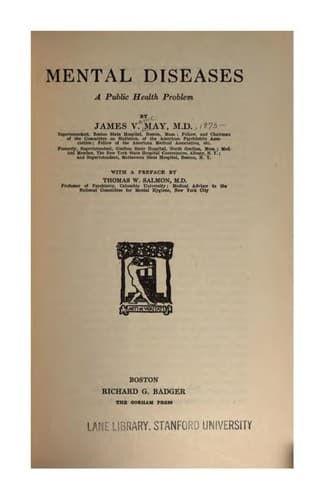
Mental diseases: a public health problemMay, James Vance
Science
Mental diseases: a public health problem
May, James Vance
Mental health services; Psychology, Pathological
Three thousand four hundred and sixty-two cases diagnosed as alcoholic
psychoses were admitted to the New York state hospitals during a
period of eight years (1912 to 1919 inclusive). Of these, pathological
intoxication constituted 2.91 per cent, delirium tremens, 5.97 per
cent, Korsakow's psychosis, 20.94 per cent, acute hallucinosis, 37.31
per cent, chronic hallucinosis, 3.66 per cent, acute paranoid states,
5.01 per cent, chronic paranoid states, 3.78 per cent, and alcoholic
deterioration, 8.34 per cent. The remainder represented miscellaneous
types variously described. These figures, of course, relate largely
to a time when there were no restrictions on the sale of alcoholic
beverages. During 1918 and 1919 the admission rate for alcoholic
psychoses in New York was only 4.58 per cent. In Massachusetts in 1919
it was 7.47 per cent, and in twenty-one other hospitals in various
states it was 5.04 per cent. A study of 34,935 first admissions to
forty-eight hospitals in sixteen different states during 1917, 1918 and
1919 showed the alcoholic psychoses to represent 5.07 per cent of the
total number. With the advent of prohibition the alcoholic psychoses
as far as this country is concerned have become a matter of little more
than historical interest. The admission rate in the New York state
hospitals for 1920 was only 1.9 per cent.
CHAPTER VIII
THE PSYCHOSES DUE TO DRUGS AND OTHER EXOGENOUS TOXINS
Opium is a drug which has been in quite common use for many centuries.
According to E. M. Holmes of London, it was known to Theophrastus
nearly three hundred years before the Christian era and two different
forms were described by Dioscorides in the neighborhood of 77 A.D.
Nicander (185 to 135 B.C.) discussed at some length the effects of a
"drink prepared from the tears which exude from poppy heads." Pliny in
the first century A.D. recorded several cases of suicide by means of
opium, which he spoke of as not being a rare occurrence. The drug is
said to have been introduced into China by the Arabs in the thirteenth
century. An edict prohibiting opium smoking was issued by the emperor
Yung Cheng in 1729. It was not until 1909 that the British government
agreed to completely prohibit the importation of morphine into China.
The sale and use of narcotics has, however, been regulated in India
for many years. Morphine, the first alkaloid ever discovered, was
isolated and named by Sertürner, a German apothecary, in 1805. Over
twenty derivatives of opium have been reported since that time. The
real history of morphinomania, according to Erlenmeyer, began in 1864.
As far as can be determined, opium was not grown in America until 1865.
In 1906 it was estimated that over thirteen millions of people were
addicted to opium smoking in China alone.
Public-domain text, read in full here on John Shaqi.
Reviews
Reviews
No reviews yet
Be the first to share your thoughts on this work.
Elsewhere in the archive
Join the Discussion
Join the discussion
Sign in to leave a comment or review.
Sign InorCreate an account