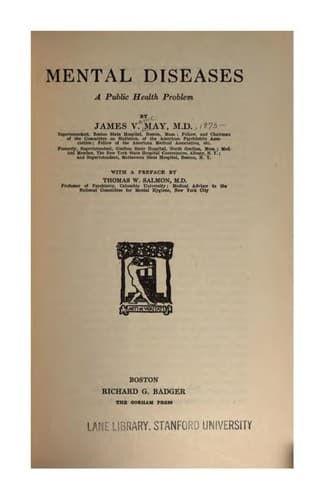
Mental diseases: a public health problemMay, James Vance
Science
Mental diseases: a public health problem
May, James Vance
Mental health services; Psychology, Pathological
The first provision for the care of mental diseases in Connecticut was
a direct result of the activities of the State Medical Society. It was
on their petition that the Hartford Retreat was chartered in 1822.
Over two thousand persons subscribed to a fund for the opening of the
hospital. These subscriptions included "$30 payable in medicine," "One
gross New London bilious pills, price $30" and two lottery tickets.[16]
About fourteen thousand dollars was subscribed in all, the citizens of
Hartford contributing four thousand. The hospital building, designed to
accommodate forty patients, was opened on April 1, 1824, and has always
been conducted on an unusually high plane. It now averages about one
hundred and seventy-five patients.
Mental cases were first provided with hospital care in Kentucky when
the Eastern State Hospital was opened in Lexington on May 1, 1824.
Governor Adams, who suggested the establishment of this institution,
in a message written in 1821 expressed the opinion that it would be of
great benefit to the students of Transylvania University, "which would
in time repay the obligation by useful discoveries in the treatment of
mental maladies."
The State Hospital at Columbia, South Carolina, was opened in December,
1828. A curious fact in connection with its history is that in 1829 the
management, having received no patients as yet, advertised for them in
the newspapers of South Carolina and adjoining states.
In 1829 the necessity of making further provision for mental diseases
in Massachusetts became the subject of a legislative investigation and
a committee was appointed "to examine and ascertain the practicability
and expediency of erecting or procuring, at the expense of the
Commonwealth, an asylum for the safe keeping of lunatics and persons
furiously mad."[17] The report of this committee, of which Horace
Mann was Chairman, is exceedingly interesting. The following is an
illustration:—"To him whose mind is alienated, a prison is a tomb,
and within its walls he must suffer as one who awakes to life in the
solitude of the grave. Existence and the capacity for pain alone are
left him. From every former source of pleasure or contentment he is
violently sequestered. Every former habit is abruptly broken off.
No medical skill seconds the efforts of nature for his recovery, or
breaks the strength of pain when it seizes him with convulsive grasp.
No friends relieve each other in solacing the weariness of protracted
disease. No assiduous affection guards the avenues of approaching
disquietude. He is alike removed from all the occupations of health,
and from all the attentions everywhere but within his homeless abode
bestowed upon sickness. The solitary cell, the noisome atmosphere,
the unmitigated cold and the untempered heat, are of themselves
sufficient soon to derange every vital function of the body, and this
only aggravates the derangement of his mind. On every side is raised up
Public-domain text, read in full here on John Shaqi.
Reviews
Reviews
No reviews yet
Be the first to share your thoughts on this work.
Join the Discussion
Join the discussion
Sign in to leave a comment or review.
Sign InorCreate an account