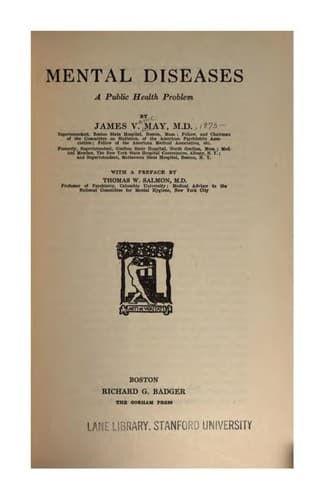
Mental diseases: a public health problemMay, James Vance
Science
Mental diseases: a public health problem
May, James Vance
Mental health services; Psychology, Pathological
Chloral-hydrate, which has been employed medicinally since 1869, is
much less frequently a cause of mental disturbance than morphine or
cocaine. Krafft-Ebing describes its use combined usually with other
drugs as causing moroseness, depression and mental dulness. He speaks,
too, of a delirium due to sudden withdrawal. This condition, he says,
may also be caused by paraldehyde. The craving for chloral, on the
part of those who have acquired the habit, is much less intense than
that for morphine or cocaine. Other drugs are very readily substituted
for that reason. A prolonged use leads to digestive disturbances,
constipation alternating with diarrhea, jaundice, flushing of the face,
congestion of the conjunctiva, fulness of the head, palpitations, weak
pulse, dyspnea and general malnutrition with erythematous, urticareous
or pustular skin eruptions, etc. Hyperesthesias, anesthesias,
paresthesias, pains in the limbs, sensations of heat and cold, tremors,
occasional loss of muscular power and sometimes ataxia appear. The
reflexes are usually decreased. Epileptiform convulsions have been
observed although they are infrequent. The mental disturbances of
chloral have been studied by Wilson.[233] He describes the habitué as
"dull, apathetic, somnolent, disposed to neglect his ordinary duties
and affairs. He passes much of his time in a state of dreamy lethargy
or in deep and prolonged sleep, from which he awakes unrefreshed and
in pain." Headache is an almost constant symptom. It is associated
with "confusion of thought, inability to converse intelligently or to
articulate distinctly, and other evidences of cerebral congestion."
Vertigo is also common. The mental state is characterized by dulness,
apathy and confusion, alternating with periods of irritability and
restlessness. The depression is not so marked as in morphinism.
Inability to concentrate the mind, loss of memory, and intellectual
enfeeblement are terminal conditions. Occasionally in the worst cases
hallucinations, delusions, clouding and states of excitement are
observed. Abstinence symptoms are headache, insomnia, neuralgia, pains
in the limbs, nervousness, restlessness and formication. A delirium
similar to that of alcoholism has been referred to by various writers.
Public-domain text, read in full here on John Shaqi.
Reviews
Reviews
No reviews yet
Be the first to share your thoughts on this work.
Elsewhere in the archive
Join the Discussion
Join the discussion
Sign in to leave a comment or review.
Sign InorCreate an account