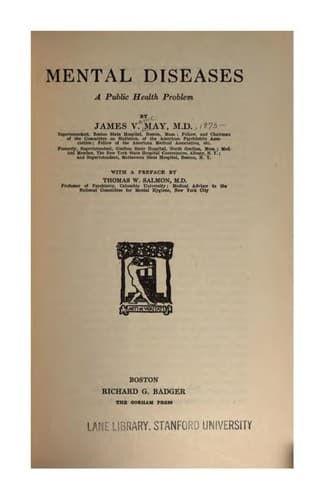
Mental diseases: a public health problemMay, James Vance
Science
Mental diseases: a public health problem
May, James Vance
Mental health services; Psychology, Pathological
In acute cocainism Kraepelin[232] finds an increased pulse rate, a
lowering of blood pressure and the appearance of an excitement of
the intoxication type with an agreeable sensation of warmth and
well-being. There is an initial motor excitement followed eventually
by weakness. This is a somewhat similar reaction to that caused by
alcohol, but it is more marked. Small doses cause the habitué to feel
elated, talkative and inclined to prolific writings. He feels a greatly
increased efficiency but does not show a corresponding productivity.
Larger doses cause delirious excitement with a tendency to sudden
collapse. After a prolonged use of the drug a condition of nervous
excitement ensues, with an increasing susceptibility to intoxication, a
mild flight of ideas, a diminished capacity for mental exertion, loss
of will power and failure of memory. The patient is busy with entirely
useless activities, quite voluble, and writes incessantly. He becomes
unreliable, forgetful, disorderly and careless in his conduct. The mood
alternates between one of well-being, irritability, suspicious anxiety
and emotional dulness. Kraepelin speaks of the great loss of weight,
increased reflexes, dilated pupils, rapid pulse, etc. Insomnia is a
common symptom. The characteristic psychosis of cocaine, however, in
his opinion is a paranoid condition somewhat resembling the alcoholic
forms. The onset is usually sudden, with irritability, suspicion
and anxious restlessness, together with the sudden development
of hallucinations of various kinds. Auditory hallucinations are
particularly numerous and are very active. The patient's surroundings
appear strange and unreal. He sees all kinds of pictures of the most
realistic type. Tactile hallucinations are very common. The patient
often shoots at his imaginary persecutors or attempts suicide to escape
them. A typical symptom is the appearance of delusions of jealousy.
With all of this the patient is usually well oriented. Only
occasionally is there a clouding of consciousness and confusion.
Insight is, however, always lacking. Even with a clear sensorium
the delusional ideas are firmly retained. The mood is excited,
irritable, sometimes angry and exasperated, but most frequently
depressed and suspicious. The conduct is characterized by restlessness
and uncertainty. There is usually a marked volubility suggesting a
conscious delirium at times. The whole development of these conditions
is rapid, often within a few weeks. They disappear as quickly in many
instances.
Chronic cocainism is very similar to the alcoholic conditions. From
a symptomatic point of view, however, the paranoid cocaine psychoses
occupy relatively an intermediate position between alcoholic delirium
and the paranoid states.
In experiments on dogs Nissl found a stainability of the achromatic
substance in the neurones, a beginning shrinkage of the cell nuclei and
a slight increase of leucocytes in the pia and vessels.
Public-domain text, read in full here on John Shaqi.
Reviews
Reviews
No reviews yet
Be the first to share your thoughts on this work.
Elsewhere in the archive
Join the Discussion
Join the discussion
Sign in to leave a comment or review.
Sign InorCreate an account