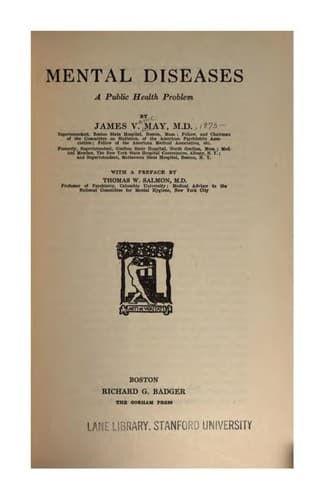
Mental diseases: a public health problemMay, James Vance
Science
Mental diseases: a public health problem
May, James Vance
Mental health services; Psychology, Pathological
A study of recent statistics would tend to show that pellagra is not at
this time a factor of importance in our institutions. In Massachusetts
in 1919 the admission rate for this disease was .33 per cent. In New
York state hospitals during a period of eight years it was only .03
per cent. In twenty-one hospitals in fourteen other states it amounted
to only 1.28 per cent. This includes a number of institutions in the
south. There were 263 cases (.37 per cent) in 70,987 first admissions
to forty-eight hospitals in sixteen different states. The admissions
reported from the southern institutions indicate that pellagrous
psychoses are comparatively infrequent as a rule. During the year 1918
pellagra constituted 10.7 per cent of the admissions to the Columbia
State Hospital. During the biennial period of 1917 and 1918 the
admission rate at the Arkansas State Hospital for Nervous Diseases was
8.31 per cent. None were admitted to the Spring Grove State Hospital
at Catonsville, Maryland. In 1919 the admission rate at the Western
State Hospital at Staunton, Virginia, was 1.14 per cent, at the Central
State Hospital, Petersburg, Virginia, 1.39 per cent, and at the Georgia
State Sanitarium at Milledgeville, 2.49 per cent. One and sixty-one
hundredths per cent of the admissions to the Louisiana State Hospital
during 1920 were diagnosed as psychoses due to pellagra. Very few cases
are reported in the northern institutions.
CHAPTER X
THE PSYCHOSES WITH OTHER SOMATIC DISEASES
Mental disturbances of various types associated with somatic
conditions and not sufficiently characteristic or circumscribed in
their symptomatology to constitute definite and separate psychoses
have long been recognized. That delirium is a complicating factor in
certain acute febrile diseases has been known for centuries. Aristotle
called attention to the occurrence of hallucinations and illusions
during the course of fevers. Hippocrates referred frequently, not only
to excitements, but to delirium and phrenitis. The word "delirus"
appears in several places in the works of Horace and many of the
early authors apparently used this term as synonymous with both mania
and melancholia. That was probably true of Sennert. Flemming in 1844
mentioned fever delirium, hallucinatory and delusional clouded states
and an encephalitic form in addition to the various alcoholic types.
Sydenham referred to the mental symptoms associated with malaria and
Bright in his original "Reports" described other delirious conditions
at some length. Sir Thomas Watson showed that the brain was uninvolved
at autopsy in the acute rheumatic affections with apparent cerebral
complications. Mental symptoms have, of course, been associated
for hundreds of years with meningitic processes. Diabetic coma was
also recognized long since. Griesinger is said by some to have been
the first to call attention to the psychoses caused by the acute
infections. Post febrile mental disturbances were, however, referred
Public-domain text, read in full here on John Shaqi.
Reviews
Reviews
No reviews yet
Be the first to share your thoughts on this work.
Elsewhere in the archive
Join the Discussion
Join the discussion
Sign in to leave a comment or review.
Sign InorCreate an account