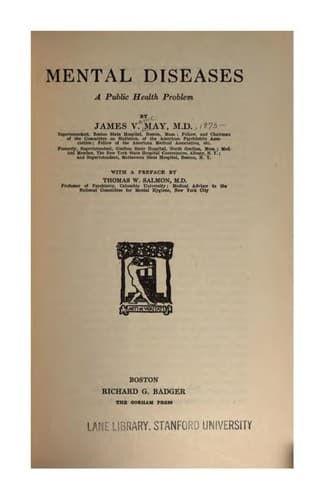
Mental diseases: a public health problemMay, James Vance
Science
Mental diseases: a public health problem
May, James Vance
Mental health services; Psychology, Pathological
The German psychiatrists during the first part of the nineteenth
century were divided into two quite separate groups. One of these
insisted that all mental diseases were purely psychic in origin, and
the other, that they were in all instances directly attributable to
somatic disease processes. The former school was ably represented by
Heinroth and Ideler and the latter by Jacobi, Nasse and Friedreich.
This led to a controversy which lasted for many years. Heinroth's views
were illustrated by his statement[262] that "Insanity is the loss of
moral liberty. It never depends upon a physical cause; it is not a
disease of the body but of the mind—a sin.... The man who has during
his whole life before his eyes and in his heart the image of God, has
no reason to fear that he will ever lose his reason.... Man possesses
a certain moral power which cannot be conquered by any physical power,
and which only falls under the weight of his own faults.... From wrong
doing springs all misfortune, including the disorders of the mind."
His principal work was a "Lehrbuch der Seelenkunde," published in
Leipsic in 1818. The teachings of the psychic school were summarized by
von Feuchtersleben[263] as follows:—"The mind is the immediate seat
of the disease, the bodily suffering is secondary. Mental disorders
may be clearly traced to their origin, Sin, Error, Passion. Diseases
of the brain, on the contrary, and of all the organs, occur, even in
their greatest intensity, without mental disturbance, as also the
latter without the former. The psychical mode of cure is that which is
properly efficient; the somatic remedies in reality act psychically;
for instance through pain, diversion of the thoughts, stupefaction,
terror. Pathological anatomy has not discovered any decided relation
between disorganization of the brain and mental disorders." In 1836
Friedreich[264]in opposing Heinroth's views outlined thirteen reasons
for believing that all psychic disorders were somatic in origin:—"1.
Because the mind cannot become diseased; 2. because the greater part
of the causes producing those conditions is somatic; 3. because in all
mental disorders there are somatic symptoms in addition; 4. because
they are too permanent for pure conditions of the mind; 5. because
they are subject to cosmical and telluric states; 6. because their
crises always take place in a material way; 7. because they are not
infrequently removed by strong material influences; 8. because the
somatic mode of cure alone has a direct sanatory effect, the psychical
at most an indirect effect on the body; 9. because the occurrence of
psychical indisposition on one side only, must arise from the duality
of the brain; 10. because the return of reason before death occurs in
cases not only of psychical, but likewise of somatic diseases, and may
be physically accounted for; 11. because mental disorders correspond
with the temperaments; 12. because it may be proved that there are
Public-domain text, read in full here on John Shaqi.
Reviews
Reviews
No reviews yet
Be the first to share your thoughts on this work.
Elsewhere in the archive
Join the Discussion
Join the discussion
Sign in to leave a comment or review.
Sign InorCreate an account