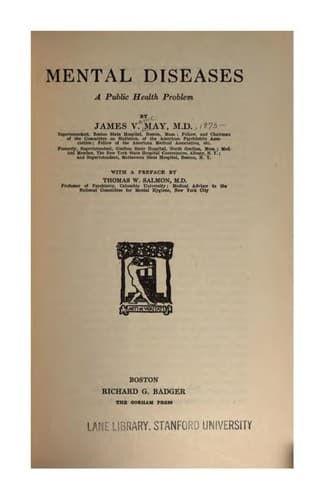
Mental diseases: a public health problemMay, James Vance
Science
Mental diseases: a public health problem
May, James Vance
Mental health services; Psychology, Pathological
In elaborating somewhat briefly the conception of the various psychoses
generally accepted by American psychiatrists, and for that reason
included in the classification adopted by the Association, every effort
has been made, as far as possible, to show the steps which have led up
to present developments. The author has endeavored to confine himself
to reflecting the views of others throughout and has used actual
quotations from recognized authorities as far as was deemed advisable.
In the discussion of the various psychoses frequent references will be
noted to the description of the various clinical groups contained in
the manual prepared by the Committee on Statistics for the American
Psychiatric Association. As is shown in the manual, these definitions
and explanatory notes were formulated by Dr. George H. Kirby.
Special reference should be made to the important contributions to
the literature of psychiatry of such well-known American writers as
Meyer, Hoch, Kirby, White, Barrett, Campbell, Southard, Peterson,
Diefendorf, Jelliffe, Paton, Salmon, Russell, Buckley, Rosanoff,
Orton, Singer and many others. The work of Kraepelin, Bleuler, Nissl,
Alzheimer, Freud, Jung, Stekel, Janet and others abroad has exercised
an influence on the psychiatry of the day which must be recognized. We
are very largely indebted to Pollock and to Furbush for the available
information relating to the incidence of the various psychoses in this
country. To the American Psychiatric, for many years the American
Medico-Psychological, Association we owe an exhaustive historical
review of the institutional care and treatment of mental diseases in
the United States and Canada.
Obviously this work was not intended as a textbook, nor was it designed
to serve the purpose of one. It is an appeal to those who are already
familiar with the fundamental principles of psychiatry. For that
reason the interpretation of mental mechanisms given so much space in
textbooks has been entirely omitted and no reference is made to the
treatment of the individual psychoses. Such reliable statistical data
as could be gathered from recent hospital reports and publications
have been utilized in full. The following institutions were represented
in this study:
1. MASSACHUSETTS—fourteen hospitals (1919-1920): Boston State
Hospital, Boston; Bridgewater State Hospital, State Farm; Danvers
State Hospital, Hathorne; Foxborough State Hospital, Foxborough;
Gardner State Colony, Gardner; Grafton State Hospital, North Grafton;
McLean Hospital, Waverley; Medfield State Hospital, Harding; Monson
State Hospital, Palmer; Northampton State Hospital, Northampton; State
Infirmary, Tewksbury (Mental Wards); Taunton State Hospital, Taunton;
Westborough State Hospital, Westborough; Worcester State Hospital,
Worcester.
Public-domain text, read in full here on John Shaqi.
Reviews
Reviews
No reviews yet
Be the first to share your thoughts on this work.
Join the Discussion
Join the discussion
Sign in to leave a comment or review.
Sign InorCreate an account