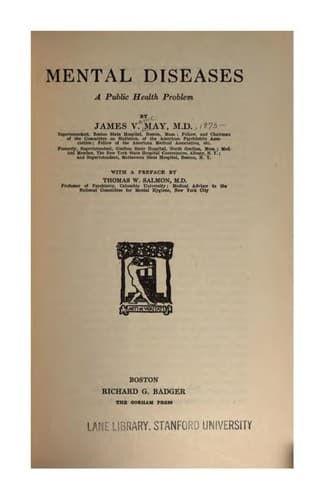
Mental diseases: a public health problemMay, James Vance
Science
Mental diseases: a public health problem
May, James Vance
Mental health services; Psychology, Pathological
They have full authority under the law
to make commitments to institutions. Hearings are required in Kansas
but inquests in lunacy may be either by jury or commission at the
discretion of the court. In Kentucky inquests in lunacy must be held by
the Circuit Court of a county. The hearings are always in the presence
of a jury. In Louisiana two physicians must examine the patient in the
presence of the court. If the physicians do not agree the judge himself
decides the case. In Maine parents and guardians may send insane
minors to an institution without a commitment. Other insane persons
are subject to examination by the municipal officers of towns. In
Mississippi the Chancery Courts have jurisdiction over writs of lunacy
and an inquest may be made by jury. Nebraska has three commissioners in
insanity in each county, appointed by the judge of the District Court.
In the case of persons found insane they issue a warrant authorizing
admission to a state hospital. Each county in New Jersey has a
commissioner in lunacy, who has jurisdiction over the steps relating
to admission to institutions. Commitments are made by the judge of a
Court of Record. All orders for commitments in North Carolina must be
made by the clerk of a Superior Court. No person who has moved into the
state while insane is deemed a resident. North Dakota has a board of
three commissioners of insanity in each county, the county judge being
a member. The commissioners authorize hospitals to receive persons
found to be insane. Appeal may be made to a commission of three persons
to be appointed by the county judge. A jury trial is provided for, on
demand, in Oklahoma. In cases of appeal the county judge must appoint
a commission of three, one of whom is a physician, for the examination
of the patient. Examination by a commission of three is required in
Pennsylvania before commitment by a justice of a Court of Common Pleas
or Quarter Sessions. South Dakota has a board of three commissioners
of insanity in each county, the county judge being a member. An insane
person may be received in a hospital in Vermont on the certificate of
two physicians or by the order of a County or Supreme Court without
a physician's certificate. Appeal may be made to the state board
of control. In Virginia the committing judge and two physicians
constitute a commission for the examination of alleged insane persons.
In West Virginia there is a county commission of lunacy composed
of the president and clerk of the County Court and the prosecuting
attorney. Commitments are ordered by the commission. On the arrival
of the patient at a hospital a board composed of the Superintendent
and assistant physicians must be convened for the examination of the
patient. Application for commitment must be made in Wisconsin by three
reputable citizens. The determination of insanity in Wyoming must be
made in all instances by a jury of six men.
Public-domain text, read in full here on John Shaqi.
Reviews
Reviews
No reviews yet
Be the first to share your thoughts on this work.
Join the Discussion
Join the discussion
Sign in to leave a comment or review.
Sign InorCreate an account