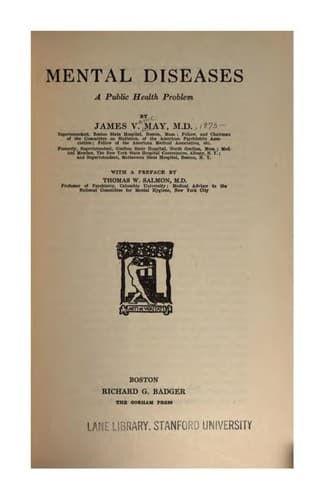
Mental diseases: a public health problemMay, James Vance
Science
Mental diseases: a public health problem
May, James Vance
Mental health services; Psychology, Pathological
In twenty-nine states voluntary patients may be received by state
hospitals. The provisions of the law usually are that the patient must
make application on his own initiative, that his mental condition
must be such as to understand the purpose of this proceeding and
the need of treatment and that he must be released on a demand in
writing in from three to seven days of such request. In the twelve
following states the temporary care of the insane in jails, usually
as an emergency measure, is still authorized:—Arkansas, Colorado,
Georgia, Indiana, Iowa, Nebraska, North Dakota, Oklahoma, South Dakota,
Virginia, West Virginia and Wisconsin. Arrangements of some kind
for the emergency care of cases pending examination and commitment
are provided for in Connecticut, Illinois, Maine, Massachusetts,
Michigan, Minnesota, New Jersey, New York, North Carolina, Oklahoma,
Pennsylvania, South Carolina, Tennessee, Washington and Wisconsin.
Massachusetts has the most comprehensive provisions for temporary care
and observation. The Superintendent of a state hospital may receive and
detain, for not more than five days without a court order, any person
whose case is "certified to be one of violent and dangerous insanity
or of other emergency" by two qualified medical examiners. Officers
authorized to serve a criminal process, or police officers, must, on
the request of the applicant or one of the examining physicians, bring
such a person to the hospital. The applicant for this form of admission
must within five days arrange for the commitment of the person so
received, or for his removal from the hospital.
Under the provisions of the Massachusetts Law a person found by two
qualified examiners to be in such mental condition that his admission
to a hospital for the insane is necessary for his proper care or
observation may be committed for a period of thirty-five days "pending
the determination of his insanity." The superintendent must discharge
such a person within thirty days if not insane or report to the
committing judge his opinion that the patient's mental condition is
such as to require a further residence in the hospital necessary.
Under the provisions of the so-called "Boston Police Act" (chapter 307
of the Acts of 1910) all persons suffering from delirium, mania, mental
confusion, delusions or hallucinations, under arrest or "who come under
the care or protection of the police of the city of Boston" shall be
taken to the Psychopathic Hospital "in the same manner in which persons
afflicted with other diseases are taken to a general hospital." Cases
suffering from delirium tremens or drunkenness may be refused by
the hospital authorities; otherwise, all such persons are admitted,
observed and cared for "until they can be committed or admitted to the
hospital or institution appropriate in each particular case" unless the
patient recovers or is discharged.
Public-domain text, read in full here on John Shaqi.
Reviews
Reviews
No reviews yet
Be the first to share your thoughts on this work.
Join the Discussion
Join the discussion
Sign in to leave a comment or review.
Sign InorCreate an account