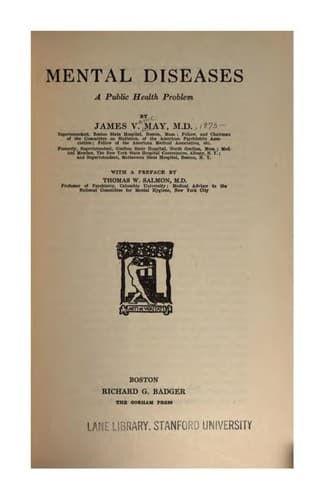
Mental diseases: a public health problemMay, James Vance
Science
Mental diseases: a public health problem
May, James Vance
Mental health services; Psychology, Pathological
movement has even reached South Africa. "Mental Hygiene"[47] has called
attention to the fact that the Cape Province Society for Mental Hygiene
has actively interested itself in the provisions discussed by the
government for the care, education and training of the feebleminded.
Two institutions are to be opened for this purpose. The Cape Province
Society has already instituted a campaign for the purpose of organizing
other local societies as well as a national council.
When Mr. Beers wrote his well-known book he evidently had in mind
more particularly the amelioration of material conditions existing
in institutions. He was looking forward to provision for the more
humane and scientific care of mental diseases. This is unquestionably
a consideration of vital importance and these objects have not
been neglected in the practical operation of the mental hygiene
organizations. Mental hygiene in its broadest sense, however, has
come to mean much more than that. The foundation of the present-day
conception of mental hygiene may be said to have been laid by Adolf
Meyer in 1906, when he described the fundamental principles which he
believed to be concerned in the development of dementia praecox. He saw
in this disease a disorder of the personality due to a deterioration
of mental habits, in other words, to faulty mental hygiene. While his
views as to the etiology of dementia praecox have not been generally
accepted, they suggested an entirely new avenue of approach to the
problem of mental diseases in general. Hoch's "shut in" personality
and Bleuler's "autismus" were more or less comparable hypotheses
which do warrant to a certain extent the tenability of such theories
as were advanced by Meyer. The same may be said of some of the
mental mechanisms advocated by Freud and others of the more purely
psychological school of psychiatrists. This viewpoint is reflected
somewhat by White[48] in his conception of childhood as the golden
period for mental hygiene. "The outstanding fact that present-day
psychiatry emphasizes is that mental illness is a type of reaction of
the individual to his problems of adjustment which is conditioned by
two factors—the nature of those problems and the character equipment
with which they are met.... Mental illnesses, defects of adjustment at
the psychological level, are therefore dependent upon defects in the
personality make-up, and as this personality make-up is what it is as
a result of its development from infancy onward, it follows that the
foundation of those defects which later issue in mental illness are to
be found in the past history of that development." He protests very
properly against accepting the theory that the characteristics of the
personality are entirely the products of germ-plasm determiners moulded
in strict accordance with the laws of heredity and therefore immutable.
Public-domain text, read in full here on John Shaqi.
Reviews
Reviews
No reviews yet
Be the first to share your thoughts on this work.
Elsewhere in the archive
Join the Discussion
Join the discussion
Sign in to leave a comment or review.
Sign InorCreate an account