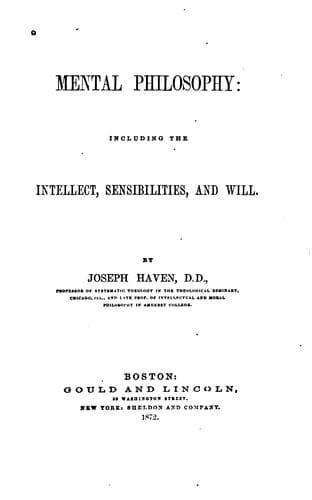
Mental Philosophy: Including the Intellect, Sensibilities, and WillHaven, Joseph
Philosophy
Mental Philosophy: Including the Intellect, Sensibilities, and Will
Haven, Joseph
Psychology
In the series of propositions, A is B, B is C, therefore A is C, the
act of mind by which I perceive that A is B, or that B is C, is not
of the same nature with that by which I perceive the consequent truth
that A is C; no mere repetition of the former act would amount to the
latter. There is a new sort of judgment in the latter case, a deduction
from the former. In order to reach it, I must not merely perceive that
A is B, and that B is C, but must also perceive the connection of the
two propositions, and what is involved in them. It is only by bringing
together in the mind these two propositions, that I perceive the new
truth, not otherwise obvious, that A is C, and the state or act of mind
involved in this latter step seems to me a different one from that by
which I reach the former judgments.
§ III.--DIFFERENT KINDS OF REASONING.
_Two Kinds of Truth._--The most natural division is that according to
the subject-matter, or the materials of the work. The truths which
constitute the material of our reasoning process are of two kinds,
_necessary_, and _contingent_. That two straight lines cannot enclose
a space, that the whole is greater than any one of its parts, are
examples of the former. That the earth is an oblate spheroid, moves in
an elliptical orbit, and is attended by one satellite, are examples of
the latter.
_The Difference lies in what._--The difference is not that one is any
_less certain_ than the other, but of the one you cannot conceive the
opposite, of the other you can. That three times three are nine, is no
more true and certain, than that Cæsar invaded Britain, or that the
sun will rise to-morrow a few minutes earlier or later than to-day.
But the one admits of the contrary supposition without absurdity,
the other does not; the one is contingent, the other necessary. Now
these two classes of truths, differing as they do, in this important
particular, admit of, and require, very different methods of reasoning.
The one class is susceptible of _demonstration_, the other admits only
that species of reasoning called _probable_ or _moral_. It must be
remembered, however that when we thus speak we do not mean that this
latter class of truths is deficient in proof; the word probable is not,
as thus used, opposed to _certainty_, but only to _demonstration_. That
there is such a city as Rome, or London, is just as _certain_ as that
the several angles of a triangle are equal to two right-angles; but
the evidence which substantiates the one is of a very different nature
from that of the other. The one can be demonstrated, the other cannot.
The one is an eternal and necessary truth, subject to no contingence,
no possibility of the opposite. The other is of the nature of an event
taking place in time, and dependent on the will of man, and might,
without any absurdity, be supposed not to be as it is.
I. DEMONSTRATIVE REASONING.
Public-domain text, read in full here on John Shaqi.
Reviews
Reviews
No reviews yet
Be the first to share your thoughts on this work.
Elsewhere in the archive
Join the Discussion
Join the discussion
Sign in to leave a comment or review.
Sign InorCreate an account