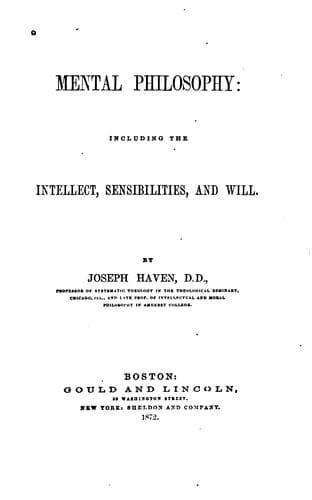
Mental Philosophy: Including the Intellect, Sensibilities, and WillHaven, Joseph
Philosophy
Mental Philosophy: Including the Intellect, Sensibilities, and Will
Haven, Joseph
Psychology
_Field of Demonstrative Reasoning._--Its field, as we have seen, is
necessary truth. It is limited, therefore, in its range, takes in only
things abstract, conceptions rather than realities, the relations of
things rather than things themselves, as existences. It is confined
principally, if not entirely, to mathematical truths.
_No degrees of Evidence._--There are no _degrees_ of evidence or
certainty in truths of this nature. Every step follows irresistibly
from the preceding. Every conclusion is inevitable. One demonstration
is as good as another, so far as regards the certainty of the
conclusion, and one is as good as a thousand. It is quite otherwise in
probable reasoning.
_Two Modes of Procedure._--In demonstration, we may proceed directly,
or indirectly; as, _e. g._, in case of two triangles to be proved
equal. I may, by super-position, prove this directly; or I may suppose
them unequal, and proceed to show the absurdity of such a supposition;
or I may make a number of suppositions, one or the other of which
_must_ be true, and then show that all but the one which I wish to
establish are false.
_Force of Mathematical reasoning._--The question arises whence the
peculiar force of mathematical, in distinction from other reasoning?--a
fact observed by every one, but not easily explained: how happens
this, and on what does it depend, this irresistible cogency which
compels our assent? Is it owing to the pains taken to define the terms
employed, and the strict adherence to those definitions? I think not;
for other sciences approximate to mathematics in this, but not to the
cogency of its reasoning. The explanation given by Stewart is certainly
plausible. He ascribes the peculiar force of demonstrative reasoning
to the fact, that the first principles from which it sets out, _i.
e._, its definitions, are _purely hypothetical_, involving no basis or
admixture of facts, and that by simply reasoning strictly upon these
assumed hypotheses the conclusions follow irresistibly. The same thing
would happen in any other science, could we (as we cannot) construct
our definitions to suit ourselves, instead of proceeding upon _facts_
as our data. The same view is ably maintained by other writers.
If this be so, the superior certainty of mathematical, over all other
modes of reasoning, if it does not quite vanish, becomes of much less
consequence than is generally supposed. Its truths are necessary in
no other sense than that certain definitions being assumed, certain
_suppositions_ made, then the certain other things follow, which is no
more than may be said of any science.
Public-domain text, read in full here on John Shaqi.
Reviews
Reviews
No reviews yet
Be the first to share your thoughts on this work.
Elsewhere in the archive
Join the Discussion
Join the discussion
Sign in to leave a comment or review.
Sign InorCreate an account