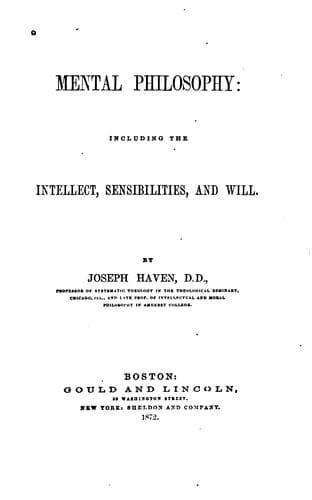
Mental Philosophy: Including the Intellect, Sensibilities, and WillHaven, Joseph
Philosophy
Mental Philosophy: Including the Intellect, Sensibilities, and Will
Haven, Joseph
Psychology
_Induction as distinguished from Deduction._--This is called
_induction_, the peculiar characteristic of which, in distinction from
deductive reasoning, is that it begins with individual cases, and from
them infers a general conclusion, whereas, the deductive method starts
with a general proposition, and infers a particular one. From the
proposition all men are mortal, the syllogism infers that Socrates is
mortal. From the fact that Socrates, Plato, Aristotle, Pliny, Cæsar,
Cicero, and any number of other individuals, are mortal, induction
leads you to conclude that all men are so. The premises here are
facts occurring within the range of observation and experience, and
the reasoning proceeds on the principle of the general uniformity of
nature and her laws. Induction, then, is, in other words, the process
of inferring that what we know to be true in certain observed cases is
also true, and will be found to be true, in other like cases which have
not fallen under our observation.
_Basis of this Mode of reasoning._--The groundwork of induction, as
I have already said, is the axiom or universal proposition of the
uniformity of nature. Take this away, and all reasoning from induction
or experience fails at once. This is a truth which the human mind is,
by its nature and constitution, always disposed to proceed upon. It
may not be embodied in the shape of a definite proposition, but it is
tacitly assumed and acted upon by all men. How came we by this general
truth. Is it _intuitive_? So say the disciples of certain schools, so
says Cousin, and so say the Scotch metaphysicians, and the German.
Others, however, contend that it is itself an induction, as truly as
any other, a truth learned from experience and observation, and by no
means the first, but rather among the latest of our inductions. Without
stopping to discuss this question, it is sufficient for our purpose to
notice the fact, that this simple truth is universally admitted, and
constitutes the basis of all reasoning from experience.
_Incorrect Mode of Statement._--The proposition is sometimes
incorrectly stated, as, _e. g._, that the future will resemble the
past. This is not an adequate expression of the great truth to which we
refer. It is not that the future merely will resemble the past merely,
but that the unknown will resemble the known. The idea of time is not
properly connected with the subject. That which is unknown may lie in
the future, it may lie in the present or the past.
Public-domain text, read in full here on John Shaqi.
Reviews
Reviews
No reviews yet
Be the first to share your thoughts on this work.
Elsewhere in the archive
Join the Discussion
Join the discussion
Sign in to leave a comment or review.
Sign InorCreate an account