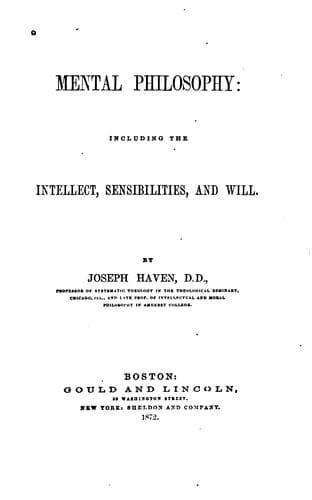
Mental Philosophy: Including the Intellect, Sensibilities, and WillHaven, Joseph
Philosophy
Mental Philosophy: Including the Intellect, Sensibilities, and Will
Haven, Joseph
Psychology
_Superstitious Belief of the Ancients._--The tendency of men to
believe in the universal permanence of nature, and, on that ground, to
generalize from insufficient data, is illustrated in the superstitious
and widely prevalent idea among the ancients, and some of the moderns
also, of grand cycles of events extending both to the natural and the
_moral_ world. According to this idea, the changes of the atmosphere,
and all other natural phenomena, as observed at any time, would, after
a period, return again in the same order of succession as before;
storms, and seasons, and times, being subject to some regular law.
It was supposed, in fact, "that all the events"--to use the language
of one of these theorists--"within the immeasurable circuit of the
universe, are the successive evolutions of an extended series, which,
at the return of some vast period, repeats its eternal round during
the endless flux of time." This is a sufficiently grand induction,
startling in its sweep and range of thought, but requiring for its
data a somewhat wider observation of facts than can fall to the lot of
short-lived and short-sighted man, during the few years of his narrow
sojourn, and pilgrimage, in a world like this.
3. _Reasoning from Analogy._
_Meaning of the term Analogy._--This word, analogy, is used with great
variety of meaning, and with much vagueness, therefore. It properly
denotes any sort of resemblance, whether of relation or otherwise; and
the argument from analogy is an argument from resemblance, an argument
of an inductive nature, but not amounting to complete induction. A
resembles B in certain respects; therefore it probably resembles it,
also, in a certain other respect: such is the argument from _analogy_.
A resembles B in such and such properties, but these are always found
connected with a certain other property; therefore A resembles B also
in regard to that property: such is the argument from _induction_.
Every resemblance which can be pointed out between A and B creates a
further and increased probability that the resemblance holds also in
respect to the property which is the object of inquiry. If the two
resembled each other in all their properties, there would be no longer
any doubt as to this one, but a positive certainty, and the more
resemblances in other respects so much the nearer we come to certainty
respecting the one that happens to be in question.
_Illustration of this Principle._--It was observed by Newton, that
the diamond possessed a very high refractive power compared with its
density. The same thing he knew to be true of combustible substances.
Hence, he conjectured that the diamond was combustible. He conjectured
the same thing, and for the same reason, of water, _i. e._, that it
contains a combustible ingredient. In both instances, he guessed
right--reasoning from analogy.
Public-domain text, read in full here on John Shaqi.
Reviews
Reviews
No reviews yet
Be the first to share your thoughts on this work.
Elsewhere in the archive
Join the Discussion
Join the discussion
Sign in to leave a comment or review.
Sign InorCreate an account