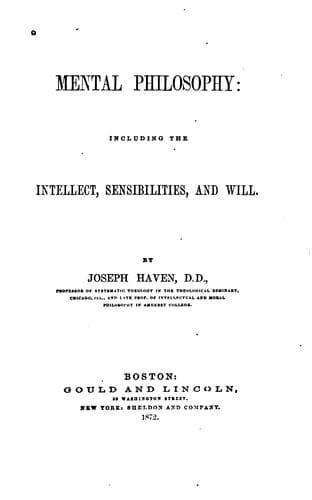
Mental Philosophy: Including the Intellect, Sensibilities, and WillHaven, Joseph
Philosophy
Mental Philosophy: Including the Intellect, Sensibilities, and Will
Haven, Joseph
Psychology
_Further Illustration of Reasoning from Analogy._--Reasoning from
analogy, I might infer that the moon is inhabited, thus: The earth is
inhabited--land, sea, and air, are all occupied with life. But the
moon resembles the earth in figure, relation to the sun, movement,
opacity, etc.; moreover, it has volcanoes as the earth has; therefore,
it is _probably_ like the earth in this other respect, that of being
inhabited. To make this out by induction, I must show that the moon
not only resembles the earth in these several respects, but that these
circumstances are in other cases observed to be connected with the one
in question; thus, in other cases, bodies that are opaque, spherical,
and moving in elliptical orbits, are known to be inhabited. The same
thing is probably true then in all cases, and inasmuch as the moon has
these marks, it is therefore inhabited.
_Counter Probability._--On the other hand, the points of dissimilarity
create a counter probability, as, _e. g._, the moon has no atmosphere,
no clouds, and therefore no water; but air and water are, on our
planet, essential to life; the presumption is, then, looking at these
circumstances merely, that the moon is uninhabited. Nay, more: if
life exists, then it must be under very different conditions from
those under which it exists here. Evidently, then, the greater the
resemblance in other respects between the two planets, the less
probability that they differ in this respect (_i. e._, the mode of
sustaining life), so that the resemblances already proved, become,
themselves, presumptions _against_ the supposition that the moon is
inhabited.
_Amount of Probability._--The analogy and diversity, when they come
thus into competition and the arguments from the one conflict with
those of the other, must be weighed against each other. The extent of
the resemblance, compared with the extent of the difference, gives
the amount of probability on one side or the other, so _far as these
elements are known_. If any region lies unexplored, we can infer
nothing with certainty or probability as to that. Suppose then, that so
far as we have had the means of observing, the resemblances are to the
differences as four to one; we conclude with a probability of four to
one, that any given property of the one will be found to belong to the
other. The chances are four out of five.
_Value of Analogical Reasoning._--The chief value of analogy,
as regards science, however, is as a guide to conjecture and to
experiment; and even a faint degree of analogical evidence may be of
great service in this way, by directing further inquiries into that
channel, and so conducting to eventual probability, or even certainty.
It is well remarked by Stewart, that the tendency of our nature is so
to reason from analogy, that we naturally confide in it, as we do in
the evidence of testimony.
Public-domain text, read in full here on John Shaqi.
Reviews
Reviews
No reviews yet
Be the first to share your thoughts on this work.
Elsewhere in the archive
Join the Discussion
Join the discussion
Sign in to leave a comment or review.
Sign InorCreate an account