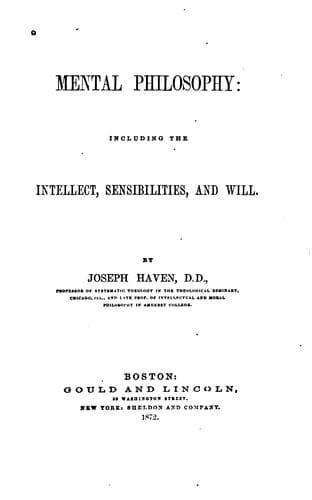
Mental Philosophy: Including the Intellect, Sensibilities, and WillHaven, Joseph
Philosophy
Mental Philosophy: Including the Intellect, Sensibilities, and Will
Haven, Joseph
Psychology
_View of Mr. Mill._--Nearly every thing which is now theory, was once
hypothesis, says Mill. "The process of tracing regularity in any
complicated, and, at first sight, confused set of appearances, is
necessarily tentative: we begin by making any supposition, even a false
one, to see what consequences will follow from it; and by observing
how these differ from the real phenomena we learn what corrections to
make in our assumption. The simplest supposition which accords with
any of the most obvious facts, is the best to begin with, because its
consequences are the most easily traced. This rude hypothesis is then
rudely corrected, and the operation repeated, until the deductive
results are at last made to tally with the phenomena. Let any one
watch the manner in which he himself unravels any complicated mass
of evidence; let him observe how, for instance, he elicits the true
history of any occurrence from the involved statements of one or of
many witnesses. He will find that he does not take all the items of
evidence into his mind at once, and attempt to weave them together; the
human faculties are not equal to such an undertaking; he extemporizes,
from a few of the particulars, a first rude theory of the mode in which
the facts took place, and then looks at the other statements, one by
one, to try whether they can be reconciled with the provisional theory,
or what corrections or additions it requires to make it square with
them. In this way, which, as M. Comte remarks, has some resemblance to
the methods of approximation of mathematicians, we arrive by means of
hypothesis at conclusions not hypothetical."
§ V.--DIFFERENT FORMS OF REASONING.
It remains to treat briefly of the _different forms_ of reasoning, as
founded in the laws of thought.
_How far these Forms fall within the Province of Psychology._--As there
are different kinds or modes of reasoning, according to the difference
of the subject-matter or material about which our reasoning is
employed, so there are certain general forms into which all reasoning
may be cast, and which, according to the laws of thought, it naturally
assumes. To treat specifically of these forms, their nature, use,
and value, is the business of _logic_; but, in so far as they depend
upon the laws of thought, and are merely modes of mental activity as
exercised in reasoning, they are to be considered, in connection with
other phenomena of the mind, by the psychologist. Briefly to describe
these forms, and then to consider their value, is all that I now
propose. I begin with the proposition, as the starting point in every
process of reasoning.
I. ANALYSIS OF THE PROPOSITION.
Public-domain text, read in full here on John Shaqi.
Reviews
Reviews
No reviews yet
Be the first to share your thoughts on this work.
Elsewhere in the archive
Join the Discussion
Join the discussion
Sign in to leave a comment or review.
Sign InorCreate an account