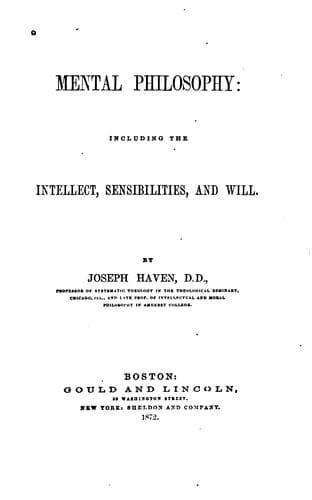
Mental Philosophy: Including the Intellect, Sensibilities, and WillHaven, Joseph
Philosophy
Mental Philosophy: Including the Intellect, Sensibilities, and Will
Haven, Joseph
Psychology
A hypothesis, it must be remembered, is any supposition, with or
without evidence, made in order to deduce from it conclusions agreeable
to known facts. If we succeed in doing this, we verify our hypothesis
(unless, indeed, it can be shown that some other hypothesis will
equally well suit these facts), and our hypothesis, when verified,
ceases to be longer a hypothesis, takes its place as known truth, and
in turn serves to explain those facts which would, on the supposition
of its truth, follow from it as a cause. It is simply a short-hand
process of arriving at conclusions in science. Suppose the problem to
be the one already named--to prove that the central force of the solar
system is one and the same with _gravity_. Now it may not be easy, or
even possible in some cases, to establish the first step or premiss
in such a chain of reasoning. The inductions leading to it may not
be forthcoming. Hypothesis steps in and supplies the deficiency, by
substituting in place of the induction a supposition. Assuming that
distant bodies attract each other with a power inversely as the square
of the distance, it proceeds on that supposition, and arrives at the
desired conclusion.
_In what Cases admissible._--Now this method is always allowable, and
strictly scientific, whenever it is possible to verify our hypothesis,
_i. e._, in every case in which it is possible to show that no law
but the one assumed can lead to these same results; that no _other_
hypothesis can accord with the facts.
In the case supposed, it would not be possible to prove that the same
movements might not follow from some other law than the one supposed.
It is not certain, therefore, that the moving force of the solar system
is identical with gravitation, _merely because_ the latter would, if
extended so far, produce the same results. In many other cases it
_is_ practicable; indeed, _in all cases where the inquiry is not to
ascertain the cause, but, the cause being already known, to ascertain
the law of its action_.
Even in cases where the inquiry is not of this nature, hypothesis is
of use in the suggestion of future investigations, and, as such, is
frequently indispensable.
Public-domain text, read in full here on John Shaqi.
Reviews
Reviews
No reviews yet
Be the first to share your thoughts on this work.
Elsewhere in the archive
Join the Discussion
Join the discussion
Sign in to leave a comment or review.
Sign InorCreate an account