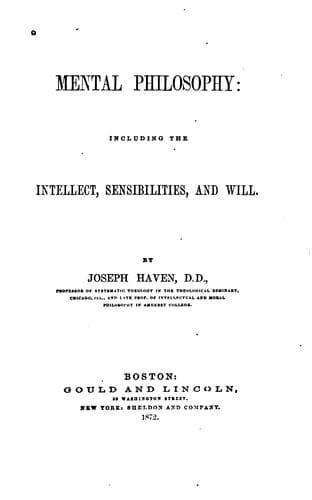
Mental Philosophy: Including the Intellect, Sensibilities, and WillHaven, Joseph
Philosophy
Mental Philosophy: Including the Intellect, Sensibilities, and Will
Haven, Joseph
Psychology
_Composition of a Syllogism._--Every syllogism contains three
propositions, of which two state the grounds or reasons, and are called
the premises, the other states the inference from those positions, and
is called the conclusion. These three propositions contain three, and
only three, distinct terms, of which one is common to both premises,
and is called the _middle_ term; the others are the extremes, one of
which is the subject of the conclusion, and is called the _minor_
term; the other the predicate of the conclusion, and is called the
_major_ term, from the fact that it denotes the class to which the
subject or minor term belongs. In the syllogism,--Every man is mortal;
Socrates is a man; therefore, Socrates is mortal,--the three terms are,
man, mortal, and Socrates: of these, Socrates, or the subject of the
conclusion, is the minor; mortal, or the predicate of the conclusion,
is the major; and man, with which both the others are compared, is the
middle term.
_Major and minor Premiss._--The premiss which contains the _major_
term, and compares it with the middle, is called the _major premiss_;
that which, in like manner, compares the _minor_ term with the middle,
is called the _minor premiss_. In the syllogism already given, 'Every
man is mortal' is the major premiss; 'Socrates is a man' is the minor
premiss.
_The Order variable._--The order of the terms in the respective
propositions, and even the order of the propositions themselves, is not
invariable, but depends on circumstances. In the above proposition, it
is immaterial whether I say, Every man is mortal, or, Mortal is every
man; it is immaterial whether I state first the major or the minor
premiss; nay, it is allowable even to state the conclusion first, and
then the grounds and reasons for the same.
III. LAWS OF SYLLOGISM.
The following rules or maxims will be found applicable to all cases,
and may be regarded as laws of the syllogism.
_Middle Term unequivocal._--_The middle term must not be
equivocal._--This rule is violated in the following syllogism. Nothing
is heavier than lead; feathers are heavier than nothing; therefore,
feathers are heavier than lead. The middle term, nothing, is here used
in different senses in the two premises.
Public-domain text, read in full here on John Shaqi.
Reviews
Reviews
No reviews yet
Be the first to share your thoughts on this work.
Elsewhere in the archive
Join the Discussion
Join the discussion
Sign in to leave a comment or review.
Sign InorCreate an account