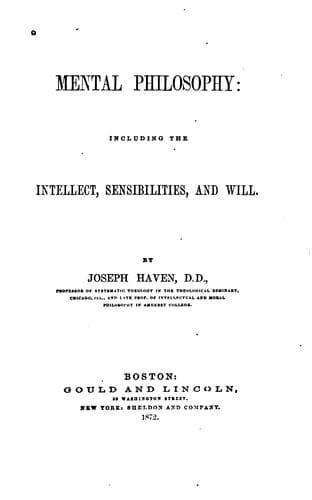
Mental Philosophy: Including the Intellect, Sensibilities, and WillHaven, Joseph
Philosophy
Mental Philosophy: Including the Intellect, Sensibilities, and Will
Haven, Joseph
Psychology
_Middle Term to be distributed._--Essentially the same thing occurs
when the middle term is not, at least once, in the premises, used in
its most complete and comprehensive sense, or, as the logicians express
it, _distributed_. As, for example, when I say, White is a color, the
term color is not here distributed, for it properly includes many
things besides white. If now I introduce into another proposition the
same term in a similar manner, as Black is a color, I evidently include
under the term, as now used, some part of the class of things denoted
by the general word color, which was not included under the same term
as first used. The color which is affirmed to agree with black, is
not the same color which is affirmed to agree with white. The term,
in fact, denotes one thing in the one proposition, and another in the
other. A syllogism thus constructed, is invalid. Hence the rule, that
the _middle term must be distributed_, or taken in its completeness,
to include the whole class which it properly denotes, _at least once
in the premises_. This is done either by making it the _subject of an
affirmative_, or the _predicate of a negative proposition_; as, All
men are mortal, or, No vice is useful. Here the term man in the one
case, and the term useful in the other, are each distributed or taken
in their completeness. There is no individual to whom the term man can
properly be applied, who is not included in the expression, all men,
nor is there any useful thing which is not here denied of vice.
_What distributed in the Conclusion._--On the same principle, _no term
must be distributed in the conclusion which was not distributed in one
of the premises_. This rule is violated in the following syllogism, All
birds are bipeds; no man is a bird; therefore, no man is a biped. Here
the term biped, in the major premiss, is not taken in its completeness,
since many creatures besides birds are bipeds. Birds are only one
sort of bipeds. In the conclusion, however, the term biped, being the
predicate of a negative proposition, is distributed, the whole class
of bipeds is spoken of, and man is excluded from the whole class. The
syllogism is, of course, invalid.
_Law of negative Premiss._--It is further a law of the syllogism, that
_from negative premises nothing can be inferred_. Also, that _if one
premiss is negative, the conclusion will be negative_.
_Law of particular Premiss._--_From two particular premises nothing
follows, but if one premiss is particular, the conclusion will be so._
These rules are too obvious, and too easily verified, to require
illustration.
IV. DIFFERENT KINDS OF SYLLOGISM.
_Syllogisms differ._--We have mentioned as yet only those properties of
the syllogism which universally belong to it. There are differences,
however, which require to be noticed, and which constitute a
distinction of some importance, presenting, in fact, two distinct kinds
of syllogism.
Public-domain text, read in full here on John Shaqi.
Reviews
Reviews
No reviews yet
Be the first to share your thoughts on this work.
Elsewhere in the archive
Join the Discussion
Join the discussion
Sign in to leave a comment or review.
Sign InorCreate an account