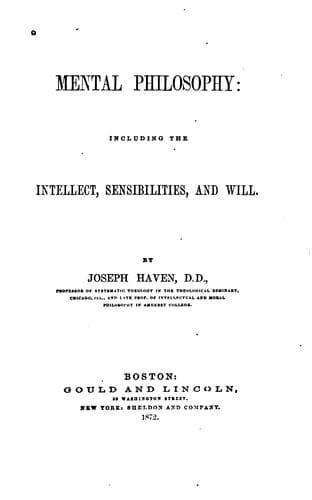
Mental Philosophy: Including the Intellect, Sensibilities, and WillHaven, Joseph
Philosophy
Mental Philosophy: Including the Intellect, Sensibilities, and Will
Haven, Joseph
Psychology
_The Form of Statement not invariable._--As there are different kinds
of syllogism, so also there are different forms in which any kind of
syllogism may be stated. These forms are not essential, pertaining to
the nature of the syllogism itself, but accidental, pertaining merely
to the order of announcing the several propositions. It has already
been remarked, in speaking of the general structure of the syllogism,
that the order of propositions is not essential. Either premiss may
precede, either follow. Nay, we may state _first the conclusion_, and
_then the reasons_, _or grounds_. This latter method, as Hamilton has
shown in his _New Analytic of Logical forms_, is perfectly valid,
though usually neglected by writers on logic. It is not only valid,
but the more natural of the two methods. When asked if Socrates is
mortal, it is more natural to say, He is mortal, for he is a man, and
all men are mortal, than to say, All men are mortal, he is a man, and
therefore, he is mortal. In fact, most of our reasoning takes the first
of these forms. The two are designated by Hamilton, respectively, as
the _analytic_ and _synthetic_ syllogism.
_Order of Premises may vary._--As to the order of the premises,
which shall precede the other, this, too, is quite unessential and
accidental. The earlier method, practised by Greek, Arabian, Jewish
and Latin schools, was to state first the minor premiss, precisely the
reverse of our modern custom.
_Order of Terms not essential._--The order of the _terms_, in the
several propositions, is also accidental rather than essential. There
are several possible and allowable arrangements of these terms with
reference to the order of precedence and succession, giving rise to
what are called _figures_ of the syllogism. These arrangements and
figures have usually been reckoned as four; three only are admitted
by Hamilton, the fourth being abolished. The first figure occurs when
the middle term is the subject of one premiss and the predicate of the
other. The second figure gives the middle term the place of predicate
in both premises. The third makes it the subject of both.
_A further Variation._--There is still another form of statement, in
which the terms compared are not, as above, severally subject and
predicate, but, in the same proposition, are both subject, or both
predicate, as when we say, A and B are equal; B and C are equal;
therefore, A and C are equal. This is a valid synthetic syllogism,
though not recognized by logicians previously to the _New Analytic_ of
Hamilton. It is termed by him the unfigured syllogism.
Public-domain text, read in full here on John Shaqi.
Reviews
Reviews
No reviews yet
Be the first to share your thoughts on this work.
Elsewhere in the archive
Join the Discussion
Join the discussion
Sign in to leave a comment or review.
Sign InorCreate an account