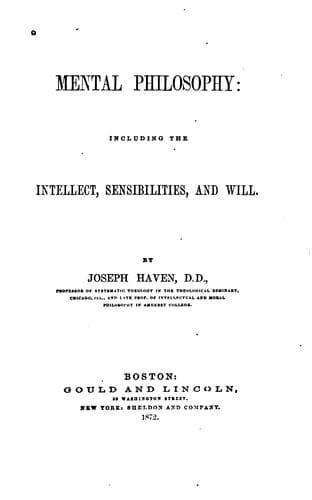
Mental Philosophy: Including the Intellect, Sensibilities, and WillHaven, Joseph
Philosophy
Mental Philosophy: Including the Intellect, Sensibilities, and Will
Haven, Joseph
Psychology
_Hypothetical reasoning not syllogistic._--It has been customary to
treat of _hypothetical_ reasoning, in its two forms of conditional and
disjunctive, as forms or kinds of syllogism. As when we say, if A is B,
C is D; but A is B, therefore C is D; or, disjunctively, either A is B,
or C is D; but A is not B, therefore C is D. These, however, are not
properly syllogisms. The inference is not mediate, through comparison
with a common or middle term, but _immediate_, whereas the syllogism
is, in all its forms, a process of mediate inference.
_Summary of Distinctions._--To sum up the distinctions now pointed
out. All inference is either immediate, as in the case of hypothetical
reasoning, whether conjunctive or disjunctive, or else mediate, as in
the syllogism. The latter may be inductive or deductive; and, as to
form, analytic or synthetic, figured or unfigured.
VI. LAWS OF THOUGHT ON WHICH THE SYLLOGISM DEPENDS.
_Statement._--There are certain universal laws of thought on which
all reasoning, and, of course, all syllogisms, depend. These
laws, according to Hamilton, are the principles of _identity_, of
_contradiction_, and of _excluded middle_; from which primary laws
results a fourth, that of _reason and consequent_.
_Law of Identity, what._--The principle of _identity_ compels us to
recognize the equivalence of a whole and its several parts taken
together, as applied to any conception and its distinctive characters.
As, for example, the sameness or equivalence of the notion man with the
aggregate of qualities or characters that constitute that notion.
_Law of Contradiction, what_.--The law of contradiction is the
principle that what is contradictory is unthinkable: as, for example,
that A has, and yet has not, a given quality, B.
_Law of excluded Middle._--The principle of _excluded middle_ is this,
that of two contradictory notions, we must think one or the other to be
true; as, that A either has or has not the quality B.
_Law of Reason and Consequent._--From these primary principles results
the law of _reason and consequent_. All logical inference is based on
that law of our nature, that one notion shall always depend on another.
This inference is of two kinds, from the whole to the parts, or from
the parts to the whole, respectively called deductive and inductive, as
already explained.
_Certain Points not included in the preceding Synopsis._--I have
presented, as was proposed, in brief outline, a synopsis of the forms
of reasoning. For a full treatment of these forms, and the laws which
govern them, the treatises on logic must be consulted.
Public-domain text, read in full here on John Shaqi.
Reviews
Reviews
No reviews yet
Be the first to share your thoughts on this work.
Elsewhere in the archive
Join the Discussion
Join the discussion
Sign in to leave a comment or review.
Sign InorCreate an account