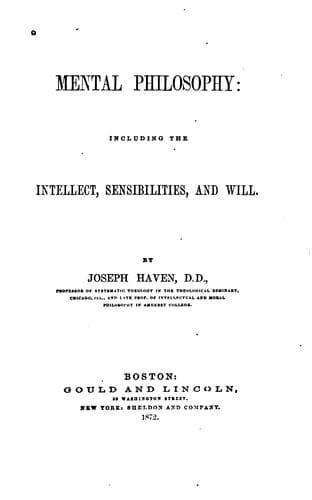
Mental Philosophy: Including the Intellect, Sensibilities, and WillHaven, Joseph
Philosophy
Mental Philosophy: Including the Intellect, Sensibilities, and Will
Haven, Joseph
Psychology
Some things usually considered essential to logical forms, as the
_modality_ of propositions and syllogisms, and the _conversion_ of the
other figures of the syllogism into the first, I have not included in
the above outline, for the reason that the former does not properly
fall within the province of logic, which has to do only with the _form_
and not with the _matter_ of a proposition or an argument, while,
as to the latter, it is only an accidental, and not an essential
circumstance, what may be the figure of a syllogism, and it is,
therefore, of no importance to reduce the second and third figures to
the first.
VII. USE AND VALUE OF THE SYLLOGISM.
Having considered the various forms which the syllogism may assume,
as also the laws or canons which govern it, we proceed to inquire,
finally, as to its _use_ and _value_ in reasoning.
_All mediate reasoning syllogistic._--It must be conceded, I think,
that all _mediate_ reasoning, all inference, which is not immediate
and direct, but which, in order to reach its conclusion, compares one
thing with another, is essentially syllogistic. The greater part of our
reasoning processes are of this sort. When fully and explicitly stated,
such reasoning resolves itself into some form of syllogism. It is not,
as sometimes stated, _a_ mode of reasoning, but _the_ mode which all
reasoning, except such as is direct and immediate, tends to assume.
Not always, indeed, is this reasoning fully drawn out and explicitly
stated, but all valid reasoning admits of being thus stated; nay, it is
not, as to form at least, complete until it is so expressed.
_Not always syllogistically expressed._--In ordinary conversation, and
even in public address, we omit many intermediate steps in the trains
and processes of our arguments, for the reason that their statement is
not essential to our being understood, the hearer's mind supplying,
for itself, the connecting links as we proceed; just as in speaking
or writing, we make many abbreviations, drop out some letters and
syllables here and there, in our hasty utterance, and yet all such
short-hand processes imply and are based upon the full form; and it
would be as correct and as reasonable to say that the fully written or
fully spoken word is merely _a_ mode of speaking and writing, which,
when the grammarian and rhetorician come into contact with common
people, they lay aside for the ordinary forms of speech, as to say that
syllogism is merely _a_ mode of reasoning, which the logician lays
aside when he comes out of his study, and reasons with other men.
Public-domain text, read in full here on John Shaqi.
Reviews
Reviews
No reviews yet
Be the first to share your thoughts on this work.
Elsewhere in the archive
Join the Discussion
Join the discussion
Sign in to leave a comment or review.
Sign InorCreate an account