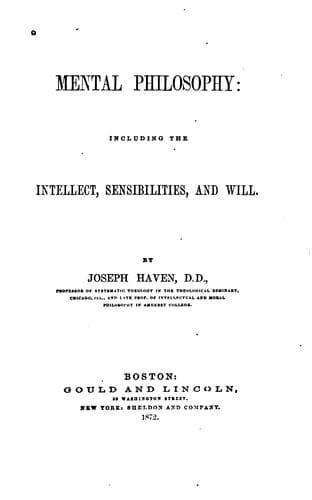
Mental Philosophy: Including the Intellect, Sensibilities, and WillHaven, Joseph
Philosophy
Mental Philosophy: Including the Intellect, Sensibilities, and Will
Haven, Joseph
Psychology
_Reference._--For a more full and exact account of Hamilton's system,
the reader is referred to the article on logic in the volume of
_Discussions on Philosophy and Literature_, by Sir W. Hamilton; also,
to "_An Essay on the New Analytic of Logical Forms_," by Thomas Spencer
Baynes, L. L. B. On the history of logic in general, see _Dictionnaire
des Sciences Philosophiques_--Article _Logique_, by Barthèleme St.
Hilaire, Professor of Philosophy to the College of France, member of
the Institute, etc., etc.; also, Blakey's _History of Logic_. The
_Memoir_ of St. Hilaire, on the logic of Aristotle, is one of the best
works of modern times on the subject of which it treats.
INTELLECTUAL FACULTIES
PART FOURTH.
INTUITIVE POWER.
CHAPTER I.
EXISTENCE AND NATURE OF THE INTUITIVE FACULTY.
_Office of this Power._--In our analysis of the powers of the mind,
one was described as having for its office the conception of truths
that lie apart from the region and domain of sense--first principles
and primary ideas, fundamental to, and presupposed in, the operations
of the understanding, yet not directly furnished by sense. They are
awakened in the mind on occasion of sensible experience, but it is
not sensible experience which produces them. On the contrary, they
spring up in the mind as by intuition, whenever the fitting occasion
is presented. We must attribute their origin to a special power of the
mind by virtue of which, under appropriate circumstances, it conceives
the truths and ideas to which we refer. This power we have termed the
_originative_ or _intuitive_ faculty.
Public-domain text, read in full here on John Shaqi.
Reviews
Reviews
No reviews yet
Be the first to share your thoughts on this work.
Elsewhere in the archive
Join the Discussion
Join the discussion
Sign in to leave a comment or review.
Sign InorCreate an account