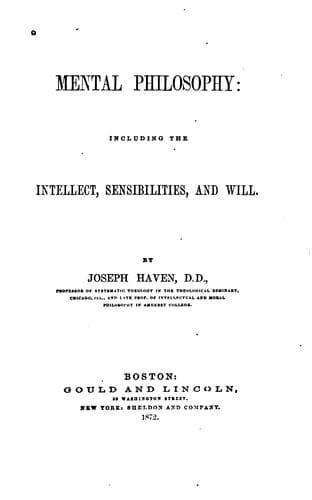
Mental Philosophy: Including the Intellect, Sensibilities, and WillHaven, Joseph
Philosophy
Mental Philosophy: Including the Intellect, Sensibilities, and Will
Haven, Joseph
Psychology
_Specific Character._--In its specific character and function it
is quite distinct from any of the faculties as yet considered. It
does not, like the presentative power, bring before us, in direct
cognizance, sensible objects; nor does it, like the representative
faculty, replace those objects to thought, in their absence. It neither
presents, nor represents, any object whatever. It forms no picture of
any thing to the mind's eye. It is a power of simple conception; and
yet it differs in an important sense from the other conceptive powers
and that is, that it is not _reflective_ but intuitive in its action.
Its data are conceptions, but conceptions necessary and intuitive,
seen at a glance, not the results of the reflective and discursive
process. These data are ideas of reason, rather than notions of the
understanding, or processes of reflection. There is no sensible object
corresponding to these ideas. We do not see, or hear, or feel, or by
any means cognize, any thing of the sort; nor can we form a picture, or
represent to ourselves any such thing as, _e. g._, time, or space, or
substance, or cause, and the like. They are conceptions of the mind,
and yet we conceive of them as _realities_. We cannot think them the
mere creations and figments of the brain. And in this respect, again,
they differ from the notions of the understanding--those classes and
genera which we know to be the mere creations of the mind.
_Existence of such a Faculty._--If any are disposed to doubt the
existence of the faculty under consideration, as a distinct power
of the mind, we have only to ask, whence come these ideas? They are
given, not by perception, evidently, nor by memory, nor by imagination,
for they fall not within the sphere of any of these faculties, that
is the sphere of sense. They relate not to the sensible, but to the
super-sensible.
Nor are they the result of abstraction, as might at first appear.
Particular instances being given, certain times, certain spaces,
certain substances, certain instances of right and wrong conduct--it
is the province of the faculty now named, to form, from these concrete
ideas, the abstract notions of time, space, etc. But whence comes, in
the first instance, the concrete idea? Whence comes the notion of a
time, a space, a substance, a cause, a right or wrong act? Abstraction
cannot give these. Manifestly, however, we have a faculty of forming
such conceptions, of perceiving such truths and realities; and as
manifestly, it is a faculty distinct from any hitherto considered.
There are such realities as time, space, substance, cause, right and
wrong, etc.,
The mind takes cognizance of them as such, knows them, and knows them
to be realities; has, therefore, the faculty of knowing such truths.
We may call it, if we please, the faculty of original and intuitive
conception.
Public-domain text, read in full here on John Shaqi.
Reviews
Reviews
No reviews yet
Be the first to share your thoughts on this work.
Elsewhere in the archive
Join the Discussion
Join the discussion
Sign in to leave a comment or review.
Sign InorCreate an account