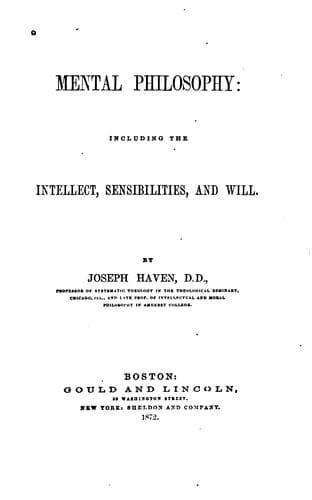
Mental Philosophy: Including the Intellect, Sensibilities, and WillHaven, Joseph
Philosophy
Mental Philosophy: Including the Intellect, Sensibilities, and Will
Haven, Joseph
Psychology
suggestion, is simply a misnomer.
_The true Doctrine._--All we can truly say, is, that the idea is
awakened or called up in the mind when the occasion presents, is
suggested _to_ it, not by it, suggested by the occasion, and not by the
mind itself. The mind has the idea within, has, moreover, the faculty
of _conceiving_ the idea, is so constituted, that, under certain
circumstances, in view of what it observes without, or is conscious of
within, the given idea is naturally and universally awakened in it; but
the _source_ of the suggestion lies not within the mind itself, and is
not to be confounded with the mind's faculty of conception.
_Use of the term by Reid and others._--Dr. Reid has been referred to
as authority for the use of the word suggestion to denote the faculty
in question. Dr. Reid makes use of the word, but not in the sense now
intended, not to denote a specific faculty of the mind, coördinate
with perception, memory, imagination, etc., not, in fact, as a faculty
at all. He refers to the well known fact, that ideas are suggested to
the mind by objects and events without, and by the sensations thus
awakened; as, _e. g._, a certain sound suggests the passing of a coach
in the street. So, also, one idea or sensation will suggest another.
He uses the term to denote the suggestion of one thing _to_ the mind
_by_ another thing, and not to denote a power in the mind of suggesting
things to itself. This is the correct use, and was not original with
Reid. Berkley had used the term in the same way before him. Locke had
used the word _excited_ in the same sense. The idea expressed by these
terms, and the use of the same or similar terms by which to express it,
may be traced back as far, at least, as to the Christian Fathers. St.
Augustine so uses it. Reid expressly applies the term to the perception
of external objects, as, _e. g._, certain sensations suggest the notion
of extension and space. This is correct use.
_The Facts in the Case._--The truth is, things exist thus and thus,
and we are constituted with reference to them as thus existing. Sense
and experience inform us of these existences and realities. Some of
them are objects of direct perception by the senses, as matter and its
qualities. Some of them are not directly objects of perception, but are
suggested to the mind by the operations of sense, and are intuitively
perceived by the mind, and recognized as truths and realities when thus
suggested, as time, space, substance, cause, the right, the wrong, the
beautiful, etc.
The mind has the faculty of receiving and recognizing such truths and
realities as thus suggested; and this faculty we call the power of
_original and intuitive conception_.
Public-domain text, read in full here on John Shaqi.
Reviews
Reviews
No reviews yet
Be the first to share your thoughts on this work.
Elsewhere in the archive
Join the Discussion
Join the discussion
Sign in to leave a comment or review.
Sign InorCreate an account