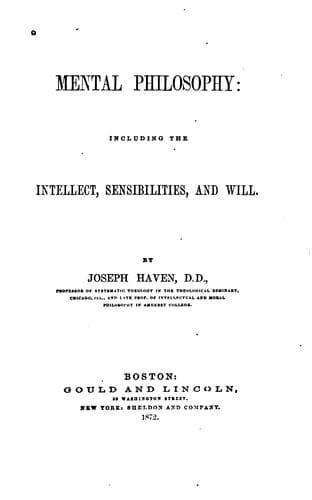
Mental Philosophy: Including the Intellect, Sensibilities, and WillHaven, Joseph
Philosophy
Mental Philosophy: Including the Intellect, Sensibilities, and Will
Haven, Joseph
Psychology
_The Idea, how awakened_--_How come we by our Idea of Space?_--Sense
gives us our first knowledge of matter, as extended, etc., and so
furnishes the _occasion_ on which the idea of space is first awakened
in the mind. In this sense, and no other, does it originate in
sensation or experience. It is a simple idea, _logically_ prior to
experience, because the very notion of matter _presupposes_ space; yet,
_chronologically_, as regards the matter of development in the mind,
subsequent to experience and cognizance of matter.
II. TIME.
_Idea and Definition._--What we have said of space will enable
us better to understand what is the nature of that analogous and
kindred conception of the mind, in itself so simple, yet so difficult
of definition and explanation--_Time._ The remarks already made,
respecting space, will almost equally apply to this subject also.
Space, we defined as the _condition of being, regarded as extended,
material_. Time is the _condition of being, regarded as in action,
movement, change_.
Sense informs us not only of magnitudes, extensions, material objects,
and existences, as around us in nature, but of movements and changes
continually taking place among these various existences; as _extension_
is essential to those material forms, so _succession_ is essential to
these movements and changes; they cannot take place, nor be conceived
to take place, without it; and as space is involved in, and given
along with, the very idea of _extension_, so time is involved in, and
given along with, the very idea of _succession_. Time, then, is the
condition of action, movement, change, event, as space is of extended
and material existence. It is that which is required in order that
something should _take place_ or occur, just as space is that which
is required in order that something should exist as material and
having form. As space gives us the question _where_, time gives us the
question _when_. It is the place of events, as space is of forms.
_Brown's View._--Dr. Brown defines time to be the mere relation of
one event to another, as prior and subsequent. It follows, from this
view, that if there were no _events_, then no _time_, since the latter
is a mere relation subsisting among the former. Is this so? No doubt
we derive our _idea_ of time from the succession of events; but is
time merely an idea, merely a conception, merely a relation, or has it
reality out of and aside from our mind's conceiving it, and independent
of the series of events that take place in it?
Public-domain text, read in full here on John Shaqi.
Reviews
Reviews
No reviews yet
Be the first to share your thoughts on this work.
Elsewhere in the archive
Join the Discussion
Join the discussion
Sign in to leave a comment or review.
Sign InorCreate an account