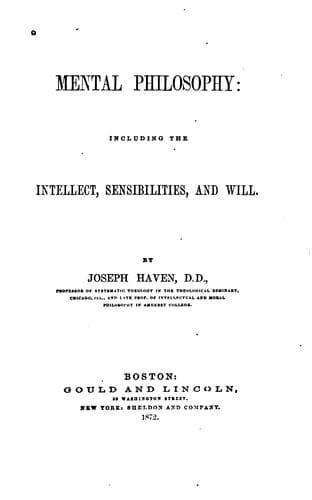
Mental Philosophy: Including the Intellect, Sensibilities, and WillHaven, Joseph
Philosophy
Mental Philosophy: Including the Intellect, Sensibilities, and Will
Haven, Joseph
Psychology
_Not a mere Conception._--Like space, it is a law of thought, a
conception, and like space it is not a _mere_ law of thought, not a
mere conception of the mind, not altogether subjective. Nor is it a
mere relation of one event to another in succession. It is, on the
contrary, _necessary to_, and prior to, all succession and all events.
It does not depend on the occurrence of events, but the occurrence
of events depends on _it_. As space would still exist were matter
annihilated, so time would continue were events to cease. But were
time blotted out there could be no succession, no occurrence or event.
Time is essential, not to the mere thought or _conception_ of events,
but to the _possibility_ of the thing itself. It is not, then, a mere
idea, or conception of the mind, nor a mere relation. It has, in a
sense, objectivity and reality, since it is the ground and condition
of all continuous active existence, as space is of all extended formal
existence, the _sine quâ non_, without which not merely our idea and
conception of such existence would vanish, but the thing itself. There
could be no such thing as active continuous existence, either of mind
or matter, since mind and spirit, as continuous and persistent in
any of its moods and phases, much more as passing from one to another
of those moods, implies succession. Time is to mind what space is to
matter. _Matter_ protends in _space_, _mind_ in _time_. Time is even
less purely subjective than space, for should we say that both matter
and space are mere subjective phenomena, mere conceptions, yet even to
those very conceptions, to those subjective phenomena, as states of
mind, time is essential.
_Whence our Idea of Time._--It is with the idea of time as with that of
space. _Logically_, time is the condition, à priori, of all experience,
because of all continuous existence and all consciousness; but
_chronologically_ it is à posteriori, _i. e._, it is, to us, a matter
of sensible experience. Sense is the occasion on which the idea of time
is first awakened in our minds. We first exist, continue to exist,
are conscious of that existence, conscious of succession, thoughts,
feelings, sensations, and so we get the idea of time.
Time is necessary to _succession_; yet had there been no succession
known to us, we should have had no _idea_ of time. We are to
distinguish, of course, between our _idea_ of time and the thing
itself. Locke is incorrect in making the idea of succession prior to
that of duration, _in itself considered_, and not merely as regards our
knowledge. In this respect, Cousin has ably and justly criticised the
philosophy of Locke.
Public-domain text, read in full here on John Shaqi.
Reviews
Reviews
No reviews yet
Be the first to share your thoughts on this work.
Elsewhere in the archive
Join the Discussion
Join the discussion
Sign in to leave a comment or review.
Sign InorCreate an account