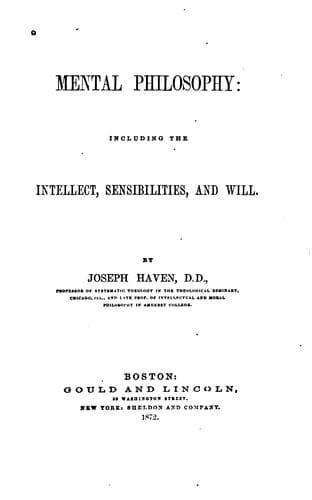
Mental Philosophy: Including the Intellect, Sensibilities, and WillHaven, Joseph
Philosophy
Mental Philosophy: Including the Intellect, Sensibilities, and Will
Haven, Joseph
Psychology
_Thus in absorbing Pursuits._--You have only, in your waking moments,
to lose sight as completely of that relation and succession of the
present self to the past self, of the me to the not me, and you lose as
completely all idea of time. Does this ever occur? Partially, whenever
the attention is absorbed in any intensely interesting pursuit or
study. Time passes insensibly then. We are abstracted from the series,
our attention is withdrawn from surrounding objects and events, and
even from our own thoughts, _as such_. We lose sight of the me, and,
of course, of the relation of the me, to passing events, and therefore
lose the sense of time. When the spell is at last broken we must go to
seek ourselves again, as we would seek a child, that, in its play, had
wandered from our side.
_Also in Disease._--Something of the same sort occurs in severe and
protracted sickness. The mind loses its reckoning, so to speak, as a
ship in a storm loses latitude and longitude, and wanders from its
course, unable longer to take its daily observations.
_Idea of Time in Children._--You have doubtless noticed that children
have little idea of time. It is much the same to them, one day with
another, one week with another; it is morning, or afternoon, or night
indifferently. The distinction and recognition of time, and of one time
as different from another, is slowly acquired, and with difficulty.
They have not that self-consciousness, that apprehension of the present
and of the past, as related to each other in the series of events,
which is involved in the idea of time. They are more like one in sleep,
like one dreaming, like one in reverie, wholly absorbed with the
present moment, the present consciousness.
_Time longer to a Child than an Adult._--What has been said explains,
also, the well-known fact, that time seems longer to a child than to
an adult person. It is, as we have seen, the relation of the present
self, as affected by changes internal and external, to the past self
as thus affected, that gives us the idea and the standard of time. Of
course, the shorter the line that represents the past, the longer, in
comparison, that present duration which is measured by it. Now the
child has fewer past thoughts and events with which to compare the
present ones; hence, they hold a greater comparative magnitude to
him than to us, who have a greater range of past existence and past
consciousness with which to connect the passing moments. Hence, the
longer we live, the more quickly pass our years, the shorter appears
any given period of duration.
_Applied to eternal Duration._--You have but to apply this thought to
Him whose going forth is from of old, who _inhabiteth eternity_, and
you have a new meaning in the beautiful thought of the Hebrew poet,
that with Him a thousand years are but as a day. To that eternal mind,
the remoteness of the period when the first star lighted up the vault
of night at his bidding, may be recent as an event of yesterday.
Public-domain text, read in full here on John Shaqi.
Reviews
Reviews
No reviews yet
Be the first to share your thoughts on this work.
Elsewhere in the archive
Join the Discussion
Join the discussion
Sign in to leave a comment or review.
Sign InorCreate an account