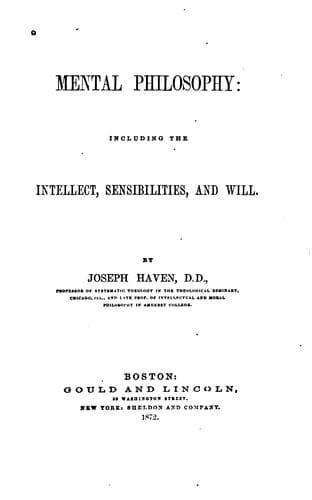
Mental Philosophy: Including the Intellect, Sensibilities, and WillHaven, Joseph
Philosophy
Mental Philosophy: Including the Intellect, Sensibilities, and Will
Haven, Joseph
Psychology
III. IDENTITY.
_Difficult of Explanation._--Perhaps no subject, in the whole range
of intellectual philosophy, has been the occasion of more perplexity
and embarrassment than this. It is, in itself, a difficult subject
to comprehend and explain. We know what we mean by identity, but to
tell what that meaning is, to state the thing lucidly, and explain it
philosophically, is another matter. It becomes necessary to examine
the subject, therefore, with some care, in order to avoid confusion of
ideas, and positively erroneous opinions. The subject is one of some
importance in its theological, as well as its strictly philosophical
bearings.
_Not Similarity._--Identity is _not similarity_, not mere
resemblance--_similar_ things are not the _same_ thing. We may suppose
two globes or spheres precisely alike in every respect--of the
same size, color, form, of the same material, of the same chemical
composition and substance, presenting to the eye and the touch, and
every other sense, the very same appearance and qualities, so that,
if viewed successively, we should not recognize the difference; yet
they are not identical; they are, by the very supposition, _two_
distinct globes, two entities, two substances, and to say that they are
identical, is to say that two things are only one. _Similarity_ is not
identity, so far from it, as Archbishop Whately has well remarked,
it is not even implied of necessity in identity. A person may so far
change as to be quite unlike his former self in appearance, size, etc.,
and yet be the same person. Not only are the two ideas quite distinct,
but the one may be, and in fact is, in most cases, the virtual
_negation_ of the other. Resemblance, in most cases, implies difference
of objects, the opposite of identity. To say that A and B resemble each
other, is to say that, as known to us, they are _not_ one and the same,
not identical. It is only when one and the same object falls under
cognizance at diverse times, so that we compare the object, as now
known, with the same object as previously known, that resemblance and
identity can possibly be predicated of the same thing.
Identity is only another term for _sameness_ (_idem_); any one who
knows what that means, knows what identity means, and that it does not
mean mere similarity or resemblance.
Public-domain text, read in full here on John Shaqi.
Reviews
Reviews
No reviews yet
Be the first to share your thoughts on this work.
Elsewhere in the archive
Join the Discussion
Join the discussion
Sign in to leave a comment or review.
Sign InorCreate an account